We have already staked out a wide
domain for the emergence of Cultural Studies even at this relatively
early point in this series of lectures. We have also, or at least I
hope we have also called into question not a few things that might
have been taken for granted or seemed “just the way the world is.”
The purpose of our introduction is not
to denounce or disavow the objects of our critique – though in
other contexts it might be appropriate to do both – nor is it to
give a special authority to Cultural Studies over other approaches
and formal disciplines. I hope that in the course of these lectures,
you will recognize that Cultural Studies is as much a cultural
artifact as are the objects of its analysis. It might appear that
academics such as myself are above the reach of the everyday, but a
quick reminder of Kant’s recognition of the Emperor’s power
should persuade you otherwise.
Understanding this point is in itself a
very good reason for asking you to view the two documentaries before
us, Michael Wood’s Hitler’s Search for the Holy Grail
and the PBS-style Degenerate Art.
Both of them illustrate the need to critique knowledge as well as
artistic production. They also set the stage for the first tendency
in Cultural Studies, the critical theory of the Frankfurt Institute
for Social Research [the “Frankfurt School”].
and holy and
wonderful being; but we must also inform him that in our State such
as he are not permitted to exist; the law will not allow them. And
so when we have anointed him with myrrh and set a garland od wool on
his head [‘tarred and feathered”], we shall send him away to
another city. For we mean to employ for our souls’ health the
rougher and severer poet or storyteller who will imitate the style of
the virtuous only, and will follow those models which we prescribe at
first when we began the education of our soldiers.” Plato,
Republic, Book III, 398.
And Socrates’ other student,
Xenophon, tells us that indeed one of the charges against Socrates
was that he had misused the poets to undermine the State: “...his
accuser alleged that he selected the most immoral passages, and used
them as evidence in teaching his companions to be tyrants and
malefactors....” Xenophon, Memorabilia, I. II., 53-57; pp.
39. Of course, as students of Socrates, each in their own way
defended him against the charges. Art effects the soul, whose care
has consequences for the State and was one of Plato’s chief
concerns in his Republic. Sorrowful or relaxing music as well
as flutes excepts those used by shepherds far from the city walls
would be banned in the Republic. Stringed instruments except
for the harp and the lyre would also be prohibited because “our
principle is that rhythm and harmony are regulated by the words, and
not the words by them.” Plato, Republic, Book III, 400.
“But shall not
our superintendence go no further, and are the poets only to be
required by us to express the image of the good in their works, on
pain, if they do anything else, of expulsion from our State? Or is
the same control to be extended to other artists, and are they also
to be prohibited from exhibiting the opposite forms of vice and
intemperance and meanness and indecency in sculpture and building
and other creative arts; and is he who can not conform to this rule
of ours to be prevented from practicing his art in our state, lest
the taste of our citizens be corrupted by him? We would not have our
guardians grow up amid images of moral deformity, as in some noxious
pasture, and here browse and feed upon many a baneful herb and flower
day by day, little by little, until they silently gather a festering
mass of corruption in their own soul. Let our artists rather be
those who are gifted to discern the true nature of the beautiful and
graceful; then will our youth dwell in a land of health, amid fair
sights and sounds,and receive the good in everything; and beauty, the
effluence of fair works, shall flow into the eye and ear, like a
health-giving breeze from a purer region, and insensibly draw the
soul from earliest years into likeness and sympathy with the beauty
of reason.
There can be no
nobler training than that, he replied. Plato, Republic, Book III, 401.
Certainly you find this idea of
committed art in, for example, Thucydides’ “Funeral Oration of
Pericles”
“When we do
kindness to others, we do not do them out of any calculations of
profit or loss: we do them without afterthought, relying on our free
liberality. Taking everything together, I declare our city is an
education to Greece.... Mighty indeed are the marks and monuments
which we have left. Future ages will wonder at us, as the present
age wonders at us now. We do not need the praises of a Homer, or of
anyone else whose words may delight us for the moment, but whose
estimation of facts will fall short of what is really there. For our
adventurous spirit has forced an entry into every sea and into every
land; and everywhere we have left behind us everlasting monuments of
good done to our friends or suffering inflicted on our enemies.”
(Thucydides, Peloponesian War, pp.119-120)
Pericles goes on to at the end implore
the wives and mothers of the dead to have and care for more children
so that they might replenish the ranks defending Athens. Where there
is a matter of the government of territory and population Art with a
capital A is never far behind. Who else designed and made all those
different kinds of uniforms, after all, so that soldiers might
recognize which territory and population that they each fought for.
And of course, the Greeks were not
alone in leaving their marks and monuments upon the landscape:
At least Pericles admits that the
Athenian monuments serve an ideological purpose; they are “an
education to Greece.”
Be that as it may for the Classical era
– and we should always be careful not to read the present back onto
the past just to suit us – for the purposes of understanding our
era, we have to begin with the premise that education, ideology, and
knowledge are ineluctably linked to each other and each is as well an
aspect of Reason, the State, and the social relations of Capital.
What we call science, and what we say it establishes as true [or
rather knowledge] changes over time. Science is the human pursuit of
knowledge of the material world, and it changes as we change the
material world and are changed by it. There are, of course, many who
would take exception to this provisional definition, and you should
take their objections seriously. No one has all of the answers,
including myself. Socrates gave us that bit of wisdom, too.
The distinction is often made between
science and scientists, that error and bias reside with the
scientists, while science corrects such errors. It might even seem
as though if only we could have better people then we would
presumably have better science as the foibles and limitations of
humans would no longer stand in the way of scientific knowledge. It
is ironic that rather than separating science from scientists, those
who sympathize with such a view are readily admitting that science is
not separate from social relations, it is just that those scientists
and naturalists of the past are often seen as having been more
gullible, more prone to error and more likely to be susceptible to
the scientific ideologies of their day then we are in ours. This is
a version of saying that we are smarter now than they were then. A
little idea of progress is always sure to message the egos of any
contemporary, no matter the era in which they thrived.
Well, one thing we can say is that
those lesser beings of our past were quite often perfectly secure in
their knowledge that they were superior to their predecessors, too.
Cultural Studies should lead us to learn humility as we, like the
Angel Novus, are thrown forward rather than the hubris that
comes with an ideology of intellectual progress.
One could argue that science is a form
of rationalist and skeptical materialism and as such has a long
history. However, the institution of the laboratory and the figure
of the scientist are of relative recent invention.
Look at these two charts from Google,
which show the references in English to Scientist, scientist,
Laboratory, laboratory, Science, and science – it is unfortunately
case sensitive – from 1800 to 2008. Notice that the term scientist
appears rather late, as it is coined by William Whewell [
http://en.wikipedia.org/wiki/William_Whewell ] in 1833 (he also gets
credit for the term “physicist,” too)
The distinction between scientists and
science also has the ultimate result of making science into something
metaphysical – another ironic aspect of the distinction – i. e.,
beyond the physical world. Making science into a metaphysical entity
(“a mysterious hieroglyphic” – to use Marx’s phrase) results
most importantly for our understanding of science, into the removing
of history and social relations. I suppose that is the point, since
the idea is to make science into something that is not effected by
the social or even, to a large degree, by its own history.
Remove science from the material of
society and history and you are left with a jaundiced science, but
also a science that might be adapted or adapt itself to any set of
historical social relations or reconciled with any history written
for the dominate ideology. Indeed, many of the errors of scientific
ideology that we would like to forget, such as the science of
Eugenics, were directed towards the government or populations and
territories.
To avoid this, one should try to see
science as having a history and this history is predominately a
history of errors, as George Canguilhem (Ideology and Rationality in the History of the life Sciences) has noted and W. P. D.
Wightman (Growth of Scientific Ideas,1951) affirmed: science
is “set in the context of the history of language & human
institutions of every kind.” After all, if science is a
self-correcting process, then even leaving aside the question of
social embeddedness for a moment, what is it correcting if not error
and what are today’s errors but yesterday’s truths? This is what
is really means to say that “science is a process.” Even the
term scientist did not exist until 1833. Was there “science’
before there were ‘scientists”? If not then science is a
relatively new invention for understanding the world and thus hardly
a candidate for being an eternal human pursuit. If the answer is
yes, then the history of science demonstrates that scientific
knowledge is conditioned by the contemporary structure of social
relations. Both views, however, leave open the possibility that
science as we know it is a product of the social transformations of
industrial society and the accompanying division of labor. Certainly
Whewell was thinking of the scientists as the embodiment of a new
rationalism.
But lets be clear that in critiquing
the authority of science we are not advocating irrationalism. Far
from it. The great materialist philosopher Epicurus responded to the
charge that he disavowed the gods by stating that it was not he who
insulted the gods, but those who affirmed the commonplace views of
the gods who truly insulted them. It is much the same with us. We
are taking science seriously, rather than degrading it by elevating
it to a metaphysical realm.
To emphasize the relation between
education, science, and ideology, I want to turn your attention to a
somewhat neglected series of events in the history of science that
Michael Wood introduces. Despite its unfortunate title, Wood shows
us how science and ideology can be linked and made to enhance the
authority of one enhances the authority of both. The documented
events are the context from which the Frankfurt School of Critical
Theory arose. It was in the midst of these and the events to be
described next week that Critical attention began to be given to the
artifacts of popular culture and everyday life.
Every successful revolution has
promoted some form of mass literacy, some grand reform of the
educational system. No matter whether the revolution was from the
left or the right. The Americans, the Soviets, the Cubans, the
Sandinistas, etc. all embarked on some form of literacy campaign.
After all, you need to be able to read the Constitution, Wall
Street Journal, Daily Worker, or whatever, for yourself.
So we should not be surprised when we take note of how central
education/knowledge was to the long-term goals of the Third Reich.
The emphasis on the purity and development of youthful bodies was not
at all discontinuous from this emphasis on knowledge. In fact, the
raising of youth for the new Reich demanded the strict regulation of
all aspects of education and knowledge, including science. What the
young German had to learn to become a National Socialist was all
important.
“For education
in the Third Reich, as Hitler envisaged it, was not to be confined to
stuffy classrooms but to be furthered by a Spartan, political and
martial training in the successive youth groups and to reach its
climax not so much in the universities and engineering colleges,
which absorbed but a small minority, but first, at the age of
eighteen, in compulsory labor service and then in service, as
conscripts, in the armed forces.... ‘The whole education by a
national state,’ he had written, ‘must aim primarily not at the
stuffing with mere knowledge but a building bodies which are
physically healthy to the core.’ But even more important, he had
stressed in his book the importance of winning over and then training
the youth in the service of ‘a new national state’ – a subject
he returned to often after he became German dictator. ‘When an
opponent declares, “I will not come over to your side,”’ he
said in a speech on November 6, 1933, ‘I will calmly say, “Your
child belongs to us already... What are you? You will pass on. Your
descendents, however, now stand in the new camp. In a short time
they will know nothing else but this new community.’” (Shirer.
[1950] 1960. The Rise and Fall of the Third Reich. p.343.)
Education was organized through the
reduction of the social status of teachers and professors except for
those who had already dedicated their careers to the study of Race
Science (Rassenkunde) or those who now embraced the view that
‘science, like every other human product, is racial and conditioned
by blood” (Shirer, p.345.)
“Every person in
the teaching professions, from kindergarten through the universities,
was compelled to join the National Socialist Teachers’ League
which, by law, was held ‘responsible for the execution of the
ideological and political coordination of all teachers in accordance
with National Socialist doctrine.’ The Civil Service Act of 1937
required teachers to be ‘the executors of the will of the
party-supported State’ and to be ready ‘at any time to defend
without reservation the National Socialist State.’ An earlier
decree has classified them as civil servants and thus subject to the
racial laws. Jews, of course, were forbidden to teach. All teachers
took an oath to ‘be loyal and obedient to Adolf Hitler.’ Later,
no one could teach who had not first served in the S. A., the Labor
Service, or the Hitler Youth. Candidates for instructorships in the
universities had to attend for six weeks an observation camp where
their views and character were studied by Nazi experts and reported
to the Ministry of Education, which issued licenses to teach based on
the candidates political ‘reliability.’” (Shirer. [1950] 1960.
The Rise and Fall of the Third Reich. p.344)
Heidegger, in his capacity as Rektor
of the University of Freiburg, sits fourth from the right at a public
demonstration of support for Nazism by German professors on 11
November 1933 in Leipzig.
http://www.think-israel.org/jan12pix/nazi.heidegger.jpg
Heidegger is in the middle of the photo as he was on his way to give his first address as Rector of
the university in 1933. https://blogger.googleusercontent.com/img/b/R29vZ2xl/AVvXsEhj6nJIOarKxTs8bN391VpVo8beJzboJugdNoP4NRk3MwiUhN8SN_WEkNKD_3aq8TX55fi2qtiGRgLiLaJ2eNU2qBK7npUaLPoEFKwCIfk6Hy_Ezx9KAFlWoTQSCVjTbW_J_RW5YC-V/s1600/Rektor.jpg
We might assume that universities were
centers of liberalism. Certainly the common view of modern American
academia is of a bastion of liberalism or even radicalism. In
neither case is this commonplace view correct. In reality, it
depends on the specific field and department. Yes it is more likely
that a sociology professor will be a liberal than a professor of
business administration, but there are far more professors of
business or engineering than there are professors of sociology.
Then, of course, there are those professors that imagine themselves
to be liberal or radical when they actually espouse conservative
positions. (For example, one commonly hears from a vocal few that “I
am a Marxist (or radical, or anarchist or committed to one or another
identity-based ‘new politics’)” and that is used to justify an
opposition to being unionized. In the old days one would hear the
call for Black separatism, which would have in fact only served to
reinforce the system of segregation that gripped America. The
examples are many. So to see the university or academics as liberal
or radical is to simply and conveniently ignore the obvious.
Universities are inherently conservative institutions where the vast
majority of students and faculty are to be found in so-called
apolitical or technical fields (e.g., engineering, medical, computer
science, forensics, etc.) or in fields that tend to affirm the
current status quo of social relations (law, business, sports,
architecture, etc.). The Frankfurt School itself owed its existence
to a wealthy philanthropist who funded it because there was no space
for them in the conventional university. It was affiliated with the
university, but was largely separate. The only other similar
institution would have been the Bauhaus, and in fact they were
created within a couple of years of each other and there was a good
deal of personal and intellectual exchange between them.
Ludwig
Mies van der Rohe designed the monument to Rosa Luxemburg and Gropius was close to Alban Berg,
Adorno’s friend and teacher. Berg’s Violin Concerto (To
the Memory of an Angel) was composed as a memorial to Gropius’
and Alma Mahler’s recently deceased 18 year-old daughter, Manon.
Anton Webern perhaps because he was too upset by Berg’s own death
in December 1935 to conduct the premiere in April 1936, but conducted
the U. K. premiere of the work only a couple of months later.
There are many other connections, and
these connections were as much due to the fact that both institutions
were quite marginal during their day and became more so as the
authoritarian movement grew until those that could fled the
continent.
“The Wiemar
Republic had insisted on academic freedom, and one result had been
that the vast majority of university teachers, anti-liberal,
undemocratic, anti-Semitic as they were, had helped to undermine the
democratic regime. Most professors were fanatical nationalists who
wished the return of a conservative, monarchical Germany.... By 1932
the majority of students appeared to be enthusiastic for Hitler.
It was surprising
to some how many members of the university faculties knuckled under
to the Nazification of higher learning after 1933. Though official
figures put the number of professors and instructors dismissed during
the first five years of the regime at 2,800 – about one fourth of
the total number – the proportion of those who lost their posts
through defying National Socialism was, as Professor Wilhem Roepke,
himself dismissed from the university of Marburg in 1933, said,
‘exceedingly small.’ Though small, there were names famous in
the German academic world: Karl Jaspers, E.I. Gumbel, Theordor Litt,
Karl Barth, Julius Ebbinghaus and dozens of others. Most of them
emigrated, first to Switzerland, Holland, and England and eventually
to America.... A large majority of professors, however, remained at
their posts, and as early as the autumn of 1933 some 960 of them, led
by such luminaries as Professors Sauerbach, the surgeon, Heidegger,
the existentialist philosopher, and Pinder, the art historian, took a
public vow to support Hitler and the National Socialist regime.
‘It was a scene
of prostitution,’ Professor Roepke later wrote, ‘that has stained
the honorable history of German learning.’” (William Shirer.
[1950] 1960. The Rise and Fall of the Third Reich, p.347)
“The new Nazi
era of German culture was illuminated not only by the bonfires of
books and the more effective, if less symbolic, measures of
proscribing the sale or library circulation of hundreds of volumes
and the publishing of many new ones, but by the regimentation of
culture on a scale which no modern Western nation had ever
experienced. As early as September 22, 1933, the Reich Chamber of
Culture had been set up by law under the direction of Dr. Goebbels.
Its purpose was defined, in the words of the law, as follows: ‘In
order to pursue a policy of German culture, it is necessary to gather
together the creative artists in all spheres into a unified
organization under the leadership of the Reich. The Reich must not
only determine the lines of progress, mental, and spiritual, but also
lead and organize the professions.’”
“Seven
subchambers were established to guide and control every sphere of
cultural life: The Reich chambers of fine arts, music, the theater,
literature, the press, radio and the films. All persons engaged in
these fields were obligated to join their respective chambers, whose
decisions and directives had the validity of law. Among other
powers, the chambers could expel – or refuse to accept – members
for ‘political unreliability,’ which meant that those who were
lukewarm about National Socialism could be, and usually were,
excluded from practicing their profession or art and thus deprived of
a livelihood.... Every manuscript of a book or a play had to be
submitted to the Propaganda Ministry before it could be approved for
publication or production. (William Shirer. [1950] 1960. The
Rise and Fall of the Third Reich, pp. 333-334.)
“After six years
of Nazification the number of university students dropped more than
one half – from 127,920 to 58,325. The decline in enrollment at
the institutes of technology, from which Germany got its scientists
and engineers, was even greater – from 20,474 to 9,554.” (William
Schirer. [1950] 1960. The Rise and Fall of the Third Reich,
pp.347-348)
But those who espoused the creation of
a German science were the extreme; less obvious still are those that
simply went along so as to either further their own careers or their
scientific fields (which no doubt in the long run would also be
personally beneficial). Some of these were swept up in the social
movements of the time, while others went about work which tellingly
could fit within the structures of either the Wiemar Republic or the
Third Reich.
Shirer may be forgiven for his
denunciation of the professors. He had witnessed the rise of
National Socialism as a reporter in Berlin and other European
capitals; interviewed most of the major and minor figures in the
years before the declaration of war between the United States and
Germany, covered the war as a combat reporter, and continued his work
during the post-war period. He was the first reporter picked by the
legendary Edward R. Murrow to work for CBS News. His radio reports
are just as notable as his later work with Edward R. Morrow (
http://en.wikipedia.org/wiki/William_L._Shirer)
As a witness to the book burnings of
May 1933, Shirer reminds us that the bonfires took place not in some
Nazi cellar or stadium rally, but “opposite the University of
Berlin” after “a torchlight parade of thousands of students.”
(Shirer, p.333) you’ve seen clips of that night and you see
glimpses of them in both documentaries. Shirer relates that some
twenty thousand books were burned that night in Berlin and at rallies
in several other cities. He gives a partial list of the authors
whose works were put to the torch:
“Thomas Mann,
Heinrich Mann, Lion Feuchtwanger, Jakob Wassermann, Arnold and Stefan
Zweig, Erich Maria Remarque, Walther Rathenau, Albert Einstein,
Alfred Kerr, and Hugo Preuss, the last named being the scholar who
had drafted the Weimar Constitution....Jack London, Upton Sinclair,
Helen Keller, Margaret Sanger, H. G. Wells, Havelock Ellis, Arthur
Schnitzler, [Sigmund] Freud, [Andre] Gide, [Emile] Zola, [ ] Proust.
In the words of a student proclamation, any book was condemned to
the flames ‘which acts subversively on our future or strikes at the
root of German thought, the German home, and the driving forces of
our people.’” (William Schirer. [1950] 1960. The Rise and
Fall of the Third Reich, p.333.)
If we had time we would look at the
chapter “The Misunderstood Poet” from Brent Engelmann’s
Everyday Life in Nazi Germany to get even more of an
understanding of how the burnings were no mere propaganda/media
events, but indicative of the changes in everyday life that many –
if they were not of a suspect class or degenerate stock – were
rapidly adjusting themselves to accommodate. Christopher Isherwood
was in Berlin during the same period as Shirer and so they give us
two nicely parallel artifacts of the era. Isherwood writes in his
Berlin Stories how much had changed during the years he taught
English in Berlin. Thugs from the SA, the forerunner of the SS, now
stood about accosting passersby and acting as moral police. One of
Isherwood’s students who had been a police chief under the Wiemar
regime took his lessons in the semi-secrecy in his car as his driver
toured them about or as they walked in a park or countryside.
Isherwood recorded various encounters and like all urban dwellers,
snatches of everyday life as he strolled the streets:
“Overheard in a
cafe: a young Nazi is sitting with his girl; they are discussing the
future of the Party. The Nazi is drunk.
‘Oh, I know we
shall win, all right,” he exclaims impatiently, ‘but first blood
must flow!’
The girl strokes
his arm reassuringly. She is trying to get him to come home. ‘But,
of course, it’s going to flow, darling,’ she coos
soothingly, ‘the Leader’s promised that in our Programme.’”
(Isherwood, The Berlin Stories, p.199)
In the chapter “Winter 1932-33”
“This morning as
I was walking down the Bulowstrasse, the Nazis were raiding the house
of a small liberal pacifist publisher. They had brought a lorry and
were piling it up with the publisher’s books. The driver of the
lorry mockingly read out the titles of the books to the crowd: ‘Nie
Wieder Krieg!’ he shouted, holding up one of them by the corner
of the cover, disgustedly, as though it were a nasty kind of reptile.
Everyone roared with laughter.
‘No More War!’
echoed a fat, well-dressed woman, with a scornful, savage laugh.
‘What an idea!’” (Isherwood, The Berlin Stories,
p.205.)
Nie
Wieder Krieg / Never Again War,
1924 ~Käthe
Kollwitz.
[This incident may
be related to the closing and sacking of the Anti-War Museum in
Berlin, which occurred in March of 1933 and the work by Ernst
Friedrich, who founded the museum, War Against War. It is one of the
most noted works in the pacifist/anarchist tradition. Be forewarned
that the images in War against War are very disturbing.
Friedrich wanted to convey the horror of war, much like Otto Dix, but
with photographs of disfigured and crippled soldiers, military executions, and the aftermath of battle. ‘Nie Wieder
Krieg! was the slogan of the
pacifist movement in the interwar period. see
http://www.anti-kriegs-museum.de/english/history.html]
Shortly after witnessing the sacking of
the office, Isherwood decided to leave Berlin for good. He relates
that when he informed Frl. Schroeder, who boarded him,
“She is
inconsolable: ‘I shall never find another gentleman like you, Herr
Issyvoo – always so punctual with the rent . . . . I’m sure I
don’t know what makes you want to leave Berlin, all of a sudden,
like this. . . .’
It’s no use
trying to explain to her, or talking politics. Already she is
adapting herself, as she will adapt herself to every new regime.
This morning I even heard her talking reverently about ‘Der Fuhrer’
to the porter’s wife. If anybody were to remind her that, at the
elections last November, she voted communist, she would probably deny
it hotly, and in perfect good faith. She is merely acclimating
herself, in accordance with a natural law, like an animal which
changes its coat for the winter. Thousands of people like Frl.
Schroeder are acclimating themselves. After all, whatever government
is in power, they are doomed to live in this town.”
(Isherwood, The
Berlin Stories, pp.206-207.)
Isherwood would later become a member
of the circle of Americans and European exiles in Los Angeles that
included Mann, Schoenberg, Adorno, Brecht, Weill, Eisler, etc. The
Berlin Stories, really two novelistic memoirs, were published in
1935 and 1939. You know some of it in a more popular form as the
basis for the musical Cabaret.
Shirer and Isherwood witnessed the
consolidation of the authority of the new regime. What struck both
of them was the degree to which the residents of Berlin quickly
acclimated themselves to the new regime. Shirer noted the effects on
himself of the relentless repetition of the ideology across the
realms of education, entertainment, culture, and knowledge. Indeed,
the Authoritarian impulse to merge all of these under the rubric of
the State was satisfied for a time.
“I myself was to
experience how easily one is taken in by a lying and censored press
and radio in a totalitarian state. Though unlike most Germans I had
daily access to foreign newspapers, especially those of London, Paris
and Zurich, which arrived the day after publication, and though I
listened regularly to the BBC and other foreign broadcasts, my job
necessitated the spending of many hours a day in combing the German
press, checking the German radio, conferring with Nazi officials and
going to party meetings. It was surprising and sometimes
consternating to find that notwithstanding the opportunities I had to
learn the facts and despite one’s inherent distrust of what one
learned from Nazi sources, a steady diet over the years of
falsifications and distortions made a certain impression on one’s
mind and often misled it. No one who has not lived for years in a
totalitarian land can possibly conceive how difficult it is to escape
the dread consequences of a regime’s calculated and incessant
propaganda. Often in a German home or office or sometimes in a
casual conversation with a stranger in a restaurant, a beer hall, a
cafe, I would meet with the most outlandish assertions from seemingly
educated and intelligent persons. It was obvious that they were
parroting some piece of nonsense they had heard on the radio or read
in the newspapers. Sometimes one was tempted to say as much, but on
such occasions one was met with such a stare of incredulity, such a
shock of silence, as if one had blasphemed the Almighty, that one
realized how useless it was even to try to make contact with a mind
which had become warped and for whom the facts of life had become
what Hitler and Geobbels, with their cynical disregard for truth,
said they were.” (William Shirer. [1950] 1960. The Rise and
Fall of the Third Reich, p.342.)
Into and from this mix come the
human-all-too-human academics, scientists, and naturalists of the
Ahnenerbe to affirm the ideology of the regime and the
scientific ideologies of race and culture, to locate the origins and
true nature of the Indo-European/Germanic volk and thus affirm
their destiny as well.
This is a good place to break before we
go on. An appropriate piece of music to hear before the second part
is this, Oliver Messiaen’s Quartet for the End of Time (1941)
http://www.youtube.com/watch?v=UeSVu1zbF94
A work for
clarinet, violin, cello and piano by Olivier Messiaen (1908-1992),
who composed the piece while being held prisoner by the Germans
during the Second World War. The quartet was premiered by clarinetist
Henri Akoka, violinist Jean le Boulaire, cellist Étienne Pasquier
and Messiaen on the piano in Stalag VIII-A in Görlitz, Germany (now
Zgorzelec, Poland) on Jan. 15, 1941, before an audience of about 400
prisoners and guards.
Käthe Kollwitz, Lithograph, Gefangene, Musik Horend
(Prisoners Listening to Music), 1925.
Canguilhem, Georges. 1988 [1977]. Ideology and Rationality inthe History of the Life Sciences. Cambridge, MA: MIT Press.
Engelmann, Bernt. 1986. In
Hitler’s Germany: Everyday Life in the Third Reich. New York:
Pantheon Books.
Gueriin, Daniel. 1973 [1965] Fascism
and Big Business. New York: pathfinder Books.
Isherwood, Christopher. 1935-1939.
The Berlin Stories. New York: New Directions.
Isherwood, Christopher. 1938. The Berlin Stories (The Last of Mr. Norris and Goodbye to Berlin. New York: New Directions.
Plato. 1892. The Dialogues of Plato translated into English with Analyses and Introductions by B. Jowett. Humphrey Milford: Oxford University Press.
Poulantzas, Nicos. 1974 [1970].
Fascism and Dictatorship: The Third International and the Problem of
Fascism. New York: Verso Books.
Shirer, William. 1960 [1950]. The
Rise and Fall of the Third Reich: A History of Nazi Germany. New
York: Fawcett Crest.
Thucydides. 1954. The Peloponnesian War. New York: Penguin Classics.
Toland, John. 1976. Adolf Hitler.
New York: Ballantine Books.
Wightman, William P. D. 1951. The Growth of Scientific Ideas. New Haven: Yale University Press.
_________________________________
Next:
Degeneracy, Culture, and Critique - Part I: Science, Reason, and
Knowledge II
Lecture I: On the Question “What is Cultural Studies?” [DRAFT] _________________________________
The immediate question that one confronts is “What is Cultural Studies?” This is a fair or even natural question to ask, but I hope that by the end of our time this semester it will not seem to be an important question.
There is a related set of questions that run something like this: “Is Cultural Studies the study of culture or is it the study of other cultures? Does it attempt to explain culture?” Let’s hold on to these question, though, and I will return to these questions a bit later in this essay/lecture.
For me, the question “What is the meaning of ‘culture’ in Cultural Studies?” is a much better question than “What is Cultural Studies?” --- if for no other reason than the question “What is Cultural Studies?” manages to carry with it the air of a judicial/administrative demand that we provide evidence of our value.
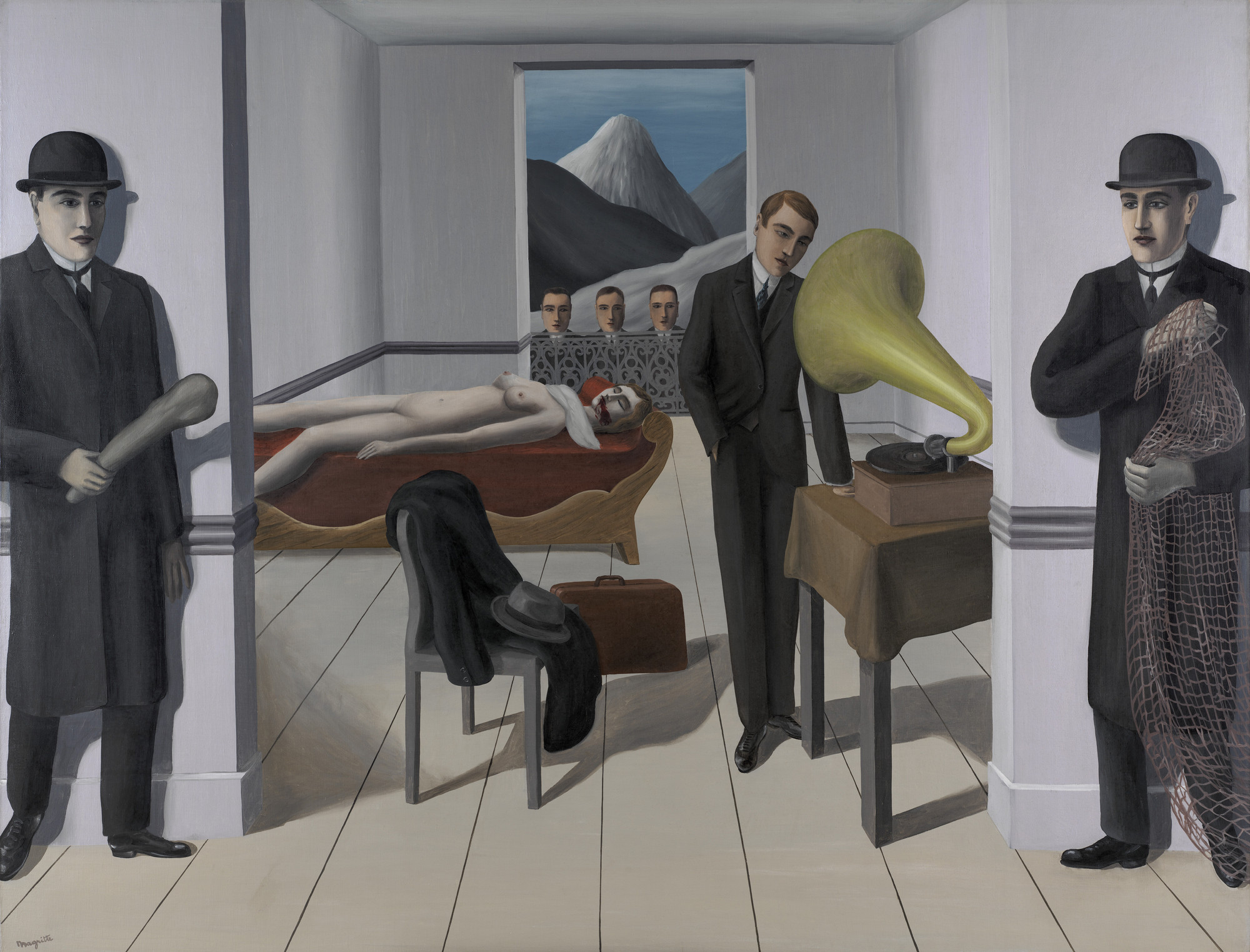
L'Assassin menacé (The Menaced Assassin)
So when I said that the question “What is Cultural Studies?” has the air of an administrative/judicial demand, I was not exaggerating. It is exactly the kind of question a college administrator would ask. There is nothing strange about this, of course administrators would want to know how to fit it into the usual organizational structure of the academy and its’ disciplines. In short, it is a question about policing the boundaries of knowledge....
...But don’t worry if you thought to ask this same question. Frankly, such things are less about you than about your having been socialized into a totally administrated society. In such a society, asking an administrative question is quite natural, perhaps even more so in college --- where one prepares to assume one’s place within the social order and where the division of labor is often quite clear.
Given this connection between administration and the question “What is Cultural Studies?”, we should not simply reject it completely out of hand. Taking this question seriously can lead us to a critical analysis of our own assumptions. If we broaden the question a bit we can ask it critically. In particular, we should consider whether the question should not also be put to the traditional or accepted disciplines as well. What is English --- or Art History, or for that matter Political Science, Sociology, Anthropology, etc? How are the objects they study --- English, art, politics, society, Man --- created and reproduced by these very disciplines? Is English the study of the language, or texts written in the language, or works in translation? (Is Shakespeare in translation Shakespeare?) English literature as opposed to non-literary texts? Likewise we might investigate whether there is a science of politics or if art can really be said to have a history, or what we mean by human?
One we begin to unpack these phrases and things – or “break them apart” as you will find it mentioned in many works, though I dislike the violence implicit in the phrase--- it becomes impossible to view knowledge as something that marches relentlessly towards one final truth. Knowledge does march on relentlessly --- as they say “Beautiful as the moon/terrible as an army with banners”
marching towards as many “truths” as the current social relations allow, all the while leaving behind the accumulated ruins of a great many more truths that were no less real and true in their day as our seem to us. There is no real comfort to be found in simply knowing that there is no single truth because knowledge and power are mutually constitutive --- they produce each other --- and authority is about imposing truths and knowledges on others. This is the function of ideology whether it is or is not the dominate ideology.
And so, although “What is Cultural Studies?” is not of much interest to those whose work is often associated with the term, it is of use to us in beginning to think about the relations of knowledge, power and authority.
I am sure you see where I am going with this: if one understands that the work in Cultural Studies was always undertaken because of an investment -- "a stake"-- in doing the analysis, then one can not ask the question “What is Cultural Studies?” as an administrative inquiry, but only as a opening to investigate the conditions that give rise to the need to ask the question.
Indeed, let’s turn back to ask “What is meant by ‘culture’ in Cultural Studies?” What continuities unite studies under the rubric of Cultural Studies?”
Now of course you know that I am going to say that there is no single answer to this question either. That is it a contentious questions and so looking at the ways in which it has been answered might tell us something about why it is so contentious. As you might have already guessed, Cultural Studies is not the place to look for final answers, but only tentative, contingent analysis.
Often in the works associated with Cultural Studies you will find reference to something being “at stake.” Generally what is at stake in Cultural Studies is understanding how knowledge, technology, institutions, and the reproduction of everyday life produce particular systems and regimes of authority and truth. It presents us with a profoundly critical analysis of how our social relations and systems of authority produce and reproduce who we are, how we reproduce those social relations in everyday life, and how through both we come to desire our own repression. In other words, Cultural Studies helps us understand how we, in Nietzsche’s words, came to be an animal with the right to make promises. It is the study of “life at the speed at which it is lived,” of “how we come to desire our own repression” of the ways in which power and authority permeate social life and our cultural artifacts represent these relations.
I do have some good company in this problem of describing Cultural Studies. If we turn to Larry Grossberg, one of the important figures in the American reception of Cultural Studies, who wrote that “there is no one Cultural Studies position. It is radically contextual.” Which means not only temporally and geographically specific, but also the meaning will change with the disciplinary context. Someone with a background in English will read and analyze the same text or phenomenon quite differently than me, despite their agreement that we both are “doing Cultural Studies.” The genealogy of Cultural Studies will be described quite differently by someone from the Humanities and someone like myself with a background in Environmental Studies, Geography and Sociology.
We might also consider these comments from Stanley Aronowitz and Raymond Williams:
“ ....cultural studies... seeks to transgress the boundaries between the humanities and the sciences, and even to transcend the boundaries of formal academic sites. At its best, cultural studies is not interdisciplinary, it is anti-disciplinary.” ---Stanley Aronowitz
“...a quite central theoretical point which to me is at the heart of Cultural Studies but which has not always been remembered... is...that you can not understand an intellectual or artistic project without also understanding its formation; that the relation between a project and a formation is always decisive... this is really what Cultural Studies has been about, of taking the best we can in intellectual work and going with it in this very open way to confront people for whom it is not a way of life, for whom it is not in any probability a job, but for whom it is a matter of their own intellectual interest, their own understanding of the pressures on them, pressures of every kind, from the most personal to the most broadly political....” --- Raymond Williams
Generally speaking these statements coincide with my approach. But again, remember that just as there is no one Cultural Studies position, so too are there many other ways to present the genealogy of Cultural Studies. [NOTE: For purposes of full disclosure, Aronowitz was my graduate school and dissertation advisor at the CUNY Graduate Center, which is where I observed the reception of Cultural Studies.]
Now to return to the statements by Grossberg, Aronowitz and Williams. Whether we agree with them or not, we can say that at least they are very clear. Yet they immediately point to the problems posed by the structures of academia and the relation of academia to what Foucault called “the government of the living.” We can see that Cultural Studies is admittedly difficult to classify or useful for governing, though this oppositional stance has weakened as the institutional respectability of Cultural Studies has grown and the popularity of “Cultural Policy Studies increase.
If there is a continuity between the texts and the persons that we will touch on this semester, it is to be found in their marginality during the periods of the World Wars and the following Cold War. They and their works did not fit comfortably within the conventional structures of knowledge and critique. It really was difficult to classify and discipline Cultural Studies. Besides, as with the term “post modernism” the phrase "Cultural Studies" was not used by many of those whose works are now closely associated with our institutionalized Cultural Studies.
And so to our two questions “Is cultural Studies the study of Culture?” and “Is it the study of other cultures?” we can say that the first is partly correct while the second is obviously false, at least in terms of the genealogy of Cultural Studies that I will be presenting to you. While the meaning of culture is so varied (see Raymond Williams’ entry on Culture in his Keywords) that no fixed object is to be found, it is certainly not anthropology. If anything, it is a reaction against the type of anthropological science that during the period of colonialism and imperialism organized our understanding of human life. The end of that era did not mean an end to its ideologies and truths, nor does it mean that those forgotten and repressed truths can not reappear in more modern form, as is the case with eugenics, for example.
Understanding this helps to make sense of the meaning of culture in Cultural Studies. Cultural Studies is not the study of exotic peoples with strange habits living either “out there” or in our own pre-history or degenerate enclaves. There was never a quest to explore or to seek out or even invent such peoples/others. The work in Cultural Studies has self-consciously focused on the West (for lack of a better word, but a word that is itself quite problematic and ideological), its popular culture, and on the ruins and promises left in the wake of Enlightenment. It has retained this orientation because our concept of culture are emblematic of our domination in the present and our repression of the past.
It has focused on these systems of knowledge, entertainment, and authority because, and this is no paradox, these all produce forms of resistance and reaction –though often short-lived and unsuccessful – to the social order that can point us toward possible alternatives.
This puts me in the position of Levi-Strauss at the start of his Tristes Tropiques: “Travel and travelers are the two things I loathe – and yet here I am, all set to tell the story of my expeditions.”
To set off, let’s consider the disciplines ones finds in every almost college and university.
Disciplines do not arise by their own accord. The social sciences and the sciences exist as they do because they are useful for providing knowledge for the government of populations and territories both real and imagined. With them, the disenchantment of Nature was furthered and once the world had been mapped and rationalized, geography in particular was no longer a viable academic field. Departments were closed or merged with other departments in a bid to become interdisciplinary, but also an acknowledgment that the field did not have an adequate answer to the administrative question “What is geography?”
Most of the disciplines that you encounter in college have come into existence quite recently and in the context of the social world of the 19th and 20th centuries and as the heirs of the Enlightenment. The critique of Enlightenment will be a topic we take up over the next several weeks. Today, though I want to give you an example to illustrate how knowledge is deeply rooted in its social context. I’ll use this one because it is elated to Enlightenment, colonialism, and the dislocations of the 19th and 20th centuries.
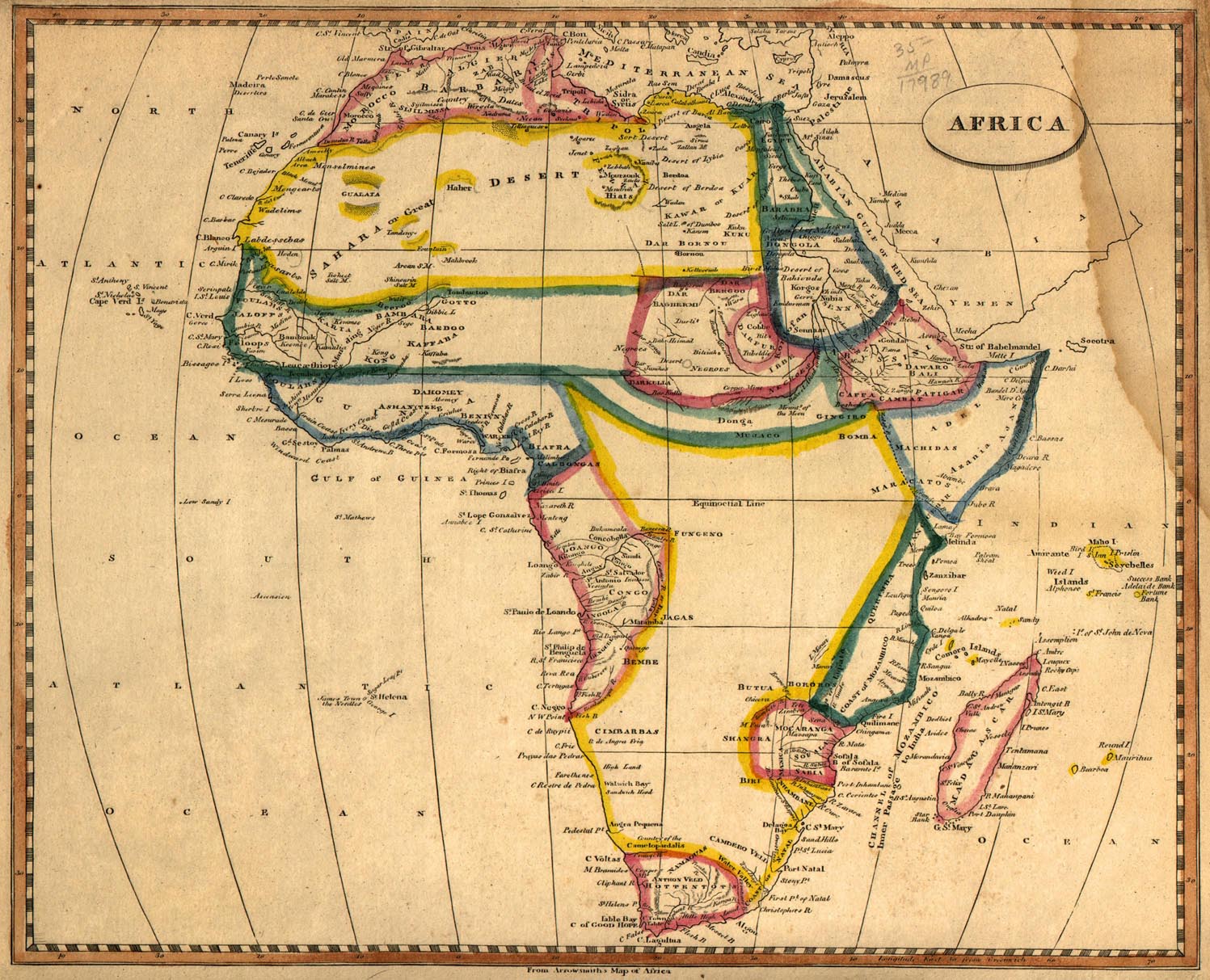
This is still our era, no matter how much we want to repress it with thoughts of living in an enlightened or sustainable age. Let me use this example of mapping to illustrate the relation of knowledge to power as well as the idea that knowledge a part of its social context. Take a look at the mapping of Africa during the rise of geography and anthropology. Both fields owe their origin to the need to provide knowledge to govern the new colonial and imperial populations and territories. I am not picking on anthropology and geography. They are relevant to drawing contrasts that make Cultural Studies a bit clearer, but disciplines forget their errors and their obsolete truths.
And just so you know, my field of sociology has its own relation to government. It too has attempted to forget whole portions of its history when that relationship proved embarrassing through its connections to social work and eugenics.
Consider this text by one of the premier philosophers of Enlightenment, Hegel, writing on the place of Africa at the beginning of the 19th century.
“Africa proper, is far as History goes back, has remained --- for all purposes of connection with the rest of the world --- shut up; it is the Gold-land compressed within itself --- the land of childhood, which lying beyond the day of self-conscious history, is enveloped in the dark mantle of Night. Its isolated character originates, not merely in its tropical nature, but essentially in its geographical condition....” Except for “European Africa” --- Northern, Mediterranean Africa, “the narrow coastal tracts” and the Nile River valley --- Africa “is almost entirely unknown to us,” it is “enveloped in the dark mantle of night” and so too are its terrible hordes, perhaps the result of an “internal movement” about which we know nothing. “For it is no historical part of the World; it has no movement or development to exhibit.... What we properly understand by Africa, is the Unhistorical, Undeveloped Spirit, still involved in the conditions of mere nature, and which had to be presented here only as on the threshold of the World’s History.” Hegel, Philosophy of History (1956 [1822]:98-99)
This is Hegel’s only mention of Africa in his Philosophy of History. He truly does simply leave it behind. In the midst of this discussion, he also notes his belief that Africans are willing to die in the thousands in defense of their lands because they have no sense of self and thus no fear of the guns of the Europeans. One wonders what Hegel would have thought of the battlefields of the American Civil War or of World War I.
In terms of the once thriving discipline of geography, the links are quite clear. Freeman in his A Hundred Years of Geography identified several trends in the modern era that were effected by colonialism and imperialism. The first of Freeman’s points are important for us today.
Freeman writes that geographical knowledge was the “collection of new information about the world” particularly Africa and North America where “there were still vast tracts... which were entirely empty on [the maps of the time]” (1961).
More than twenty years later, Johnson in his Geography and Geographers also discusses what he calls “the colonial trend” based upon “Britain, whose empire was being consolidated and developed... and covering a considerable portion of the earth’s surface. Organization of the commercial world required a great deal of information about the various countries concerned, the provision of which became a major task of [geography]” (Johnston 1983). Neither Freeman nor Johnston were being critical at all. They were simply noting two historical trends that they do not find objectionable. On the contrary, the rise of geography was for them something to be appreciated against the backdrop of global transformation.
A more critical and nuanced description of the time can be found in Conrad’s Heart of Darkness.
"Now when I was a little chap I had a passion for maps. I would look for hours at South America, or Africa, or Australia, and lose myself in all the glories of exploration. At that time there were many blank spaces on the earth, and when I saw one that looked particularly inviting on a map (but they all look that) I would put my finger on it and say, 'When I grow up I will go there.' The North Pole was one of these places, I remember. Well, I haven't been there yet, and shall not try now. The glamour’s off. Other places were scattered about the hemispheres. I have been in some of them, and . . . well, we won't talk about that. But there was one yet -- the biggest, the most blank, so to speak -- that I had a hankering after.
True, by this time it was not a blank space any more. It had got filled since my boyhood with rivers and lakes and names. It had ceased to be a blank space of delightful mystery -- a white patch for a boy to dream gloriously over. It had become a place of darkness.
Once, I remember, we came upon a man-of-war anchored off the coast. There wasn't even a shed there, and she was shelling the bush. It appears the French had one of their wars going on thereabouts. Her ensign dropped limp like a rag; the muzzles of the long six-inch guns stuck out all over the low hull; the greasy, slimy swell swung her up lazily and let her down, swaying her thin masts. In the empty immensity of earth, sky, and water, there she was, incomprehensible, firing into a continent. Pop, would go one of the six-inch guns; a small flame would dart and vanish, a little white smoke would disappear, a tiny projectile would give a feeble screech -- and nothing happened. Nothing could happen. There was a touch of insanity in the proceeding, a sense of lugubrious drollery in the sight; and it was not dissipated by somebody on board assuring me earnestly there was a camp of natives -- he called them enemies! -- hidden out of sight somewhere.”
Before Hegel’s day, one might find a map like this one:
Africa,
map from 1630
This map is of course almost completely fanciful or at best based upon classical sources.
This next map is notable because it is signed by Moll, who identifies himself as a Geographer.
Map
of Africa by H. Moll,Geographer, 1729.
While leaving aside the Medieval elements we found in the first map, this one also attempt to fill in the spaces. Note the presence of many geographical names no longer in use, such as “Negroland” and how Ethiopia stretches across the continent from the “Eastern Indian Ocean” to the “Ethiopian Sea” in the west. But more importantly, this map signals the organization of geography as a discipline.
By Hegel’s time, we are getting more honest maps, if less detailed.
And finally we see that in Hegel’s time, the map of Africa now looked like this. Note the recognition of there being “Regions Unexplored”:
Map
of Africa, 1824
Now, that was a play on words that I would not expect you to get, and that’s fine. Why should you? But in Hegel, the term recognition has a very special meaning and is a central aspect of Hegel’s Phenomenology of Spirit. It is through the recognition of an “other” that the Absolute Spirit comes to understand itself.
The Phenomenology is a phenomenological description of human existence. That is to say, it describes human experience as it ‘appears’ or ‘manifests’ itself to the very one who experiences it. In other words, Hegel describes the content of the self-consciousness of man, whose existence is dominated either by by one of the typical existential attitudes that are found everywhere and at all times... or by an attitude characterizing an outstanding historical epoch.... (Kojeve 1969:261)
And in the period following Hegel, the historical attitude was one of exploration, mapping, and the disenchantment of the world. We will encounter Hegel a few more times this semester – whether we want to or not – so hold on to this description of the Phenomenology.
This 1895 map of central Africa showing the exploration dates and routes illustrates, I think, the expansion of power and knowledge of the world as well.
By the end of the 19th century, much of the world was known and claimed by the European powers. The role of anthropology and geography in this process was captured by Hazen in his 1917 textbook:
“European annexation waited upon exploration. Africa was the 'Dark Continent,' and until the darkness was lifted it was not converted. About the middle of the century the darkness began to disappear. Explorers penetrated farther and farther into the interior, traversing the continent in various directions, opening a chapter of geographical discovery of absorbing interest.... by 1880, the scientific enthusiasm and curiosity, the missionary and philanthropic zeal of Europeans, and the hatred of slave-hunters who plied their trade in the interior, had solved the great mystery of Africa, the map showed rivers and lakes where previously all had been blank. Upon discovery quickly followed appropriation.” Charles Downer Hazen, 1917. Modern European History. New York: Henry Holt and Company. 508-509.
Again, Hazen is also not critical of what he calls “European annexation.” As a result of exploration and annexation, Africa was no longer Hegel’s Dark Continent, but instead had finally been filled in. Notice who also supplied this knowledge: the curious, missionaries, and slave traders. Regardless, “a chapter of geographical discovery of absorbing interest” had opened and was in fact already shutting by 1880.
We might see this if we simply compare two maps of the British Empire:
It was no exaggeration that the sun never set on the British Empire, but in fact the sun did begin to set less than two decades after these maps were produced.
Like geography, the modern period of Anthropology was equally altered by its relation to the state apparatus and its need for knowledge of the world. On the one hand,anthropology provided a theory of social evolution that has its origins in the Enlightenment and creation of “the West” and “the non-West”. On the other hand, anthropological science, through its tradition of field work, filled out the “empty spaces” on the geographers maps and the ideology of the West. The anthropologist described the “cultures” of “other” peoples. As Eric Wolfe wrote in his Europe and the People Without History:
“The anthropologist who went out to consult the savages of the four corners of the earth” sought “to make sense of [his subjects] unfamiliar physiques, their bizarre behavior, the strange objects they produced. He had to measure skulls, to collect things, to observe seemingly extravagant actions....” The anthropologist approached his subject in the same manner that a naturalist approached nature, employing the “techniques of the museum collector, the human biologist, and the field observer....” (10-11).
Africa at the beginning of World War I.
One thing I can tell you is that Cultural Studies is not anthropology. It is opposed to the forces that created disciplines like anthropology and also geography, although at the same time the effects of imperialism, progress, and enlightenment also created a space for Cultural Studies to emerge as a critique.
With the end of World War II, many observers note a profound shift in the order of the world.
1] the end of colonialism
2] the de-centering of Europe (and the “European Man”) as the key referent
3] the rise of the United States and the globalization of American culture
To which I would add a fourth, the Rise of Fascism and Authoritarianism, and societies of terror[i.e., control of everyday life and acceptance of authority]
One might also note the present de-centering of the United States that appears to be moving at an accelerated pace as the “American Century” comes to an end after only c.60 years.
I will talk much more about these points next week because there is no time to do so today.
To conclude, I want to do a couple of things in this course:
1] Introduce you to a fairly wide ranging field of work that is for some an intellectual orientation, and for an increasing number of others, an new academic discipline. The differences between the two views are great, as we will see, and has led to differences in style, audience, critique, and politics.
2] To show how and where the currents that became Cultural Studies emerged, and the interventions by those whose work falls under the rubric of Cultural Studies in the important questions of their day and our own.
3] To dislodge some assumptions about knowledge and power.
We will spend the semester examining the origins of Cultural Studies and its later reception in the United States. The genealogy here is complex and for the most part we will look at the continuing importance of the Critical Theory of the Frankfurt School and the groundbreaking work of those in Birmingham and elsewhere in the U.K. The following chart is something of a schematic of the relationships we will be considering, and yet it is hopelessly simplistic and incomplete. However, it will give you some small sense of who we will encounter and their place in Cultural Studies over time, a sense that you can over time correct on your own.