*****
Includes Bibliography for Parts One, Two, and Three of the Lecture-cast.
******
NOTE: this is an unedited version of the transcript for the
lecture-cast. It may differ from the final recorded version. That
version and the other two parts of the lecture-cast can be found at the
links below:
DESCRIPTION:
We are going to take a piece of music (Charles Ives’ The Unanswered
Question) and look at how Bernstein and Adorno used it as a means to
delve deeply into these questions regarding the meaning of crisis and
the expression of social transformation. As a preliminary to that
discussion, in part one we are going to review a few examples of the
varieties of expression and experiences of Bernstein's "crisis of
ambiguity". Can music be expressive of a time and place, and if so, what
is the meaning of these expressions? Is Pierre Boulez correct when he
says that: “An idea does not exist until we realize how it may be used.
In musical terms, there is no such thing as an idea in itself, it is a
reaction to our whole cultural environment." – Pierre Boulez. “Idea,
Realization, Craft.” Music Lessons: Lectures at the College de France.
This
recording was prepared for the course SS.235, Sociology of
Music/Sound/Noise, Department of Social Science & Culture Studies,
Pratt Institute. Spring 2020. Additional materials are available on the
course LMS site.
Ives, Bernstein and Adorno on the Crisis/Crises of the 20th Century, Part I.
https://archive.org/details/brbiii-20th-century-crisis-bernstein-ives-adorno-part-one
https://culturalstudieslectures.blogspot.com/2020/04/ives-bernstein-and-adorno-on.html
Unedited Lecture Notes & Slides: https://culturalstudieslectures.blogspot.com/2020/08/ives-bernstein-and-adorno-on.html
Ives, Bernstein and Adorno on the Crisis/Crises of the 20th Century, part II: Music and the Culture Industry.
https://archive.org/details/brbiii-20th-century-crisis-bernstein-ives-adorno-part-two-lq
https://culturalstudieslectures.blogspot.com/2020/04/ives-bernstein-and-adorno-on.html
Unedited Lecture Notes & Slides: https://culturalstudieslectures.blogspot.com/2020/08/ives-bernstein-and-adorno-on_9.html
Ives, Bernstein and Adorno on the Crisis/Crises of the 20th Century, Part III: An Anti-Critique.
https://archive.org/details/brbiii-20th-century-crisis-bernstein-ives-adorno-part-three-anti-critique
https://culturalstudieslectures.blogspot.com/2020/04/ives-bernstein-and-adorno-on.html Unedited Lecture Notes & Slides: https://culturalstudieslectures.blogspot.com/2020/08/ives-bernstein-and-adorno-on_7.html
*********************************

PART
THREE: Anti-critique
Greetings
again everyone for this third part of the lecture-cast.
This
time I want to respond to some criticisms that were made of the
original version by a friend and colleague who was kind enough to ask
some very important questions. So I will try to respond to her
critique as best I can.
My
critic raises the question:
“-When
is a crisis a crisis, and when is it just historical change? (I am
thinking of an argument Foucault makes somewhere in the Archeology
of Knowledge)”
And
further elaborates on this question:
“-The
distribution of literacy already started with the printing press and
the Protestant Reformation (another crisis?). Feudalism took hundreds
of years to break down, and did so unevenly throughout Europe. In
some places it never really took hold. It was always an
‘idealization.’ History has need of these big concepts that don't
always reflect what was actually happening at the micro-level of
forces. (Not saying I don't need the big concepts). I think
historians of modernity and industrial revolution like to claim that
their crisis was THE
crisis, but what about the disintegration of the Roman Empire or the
(warning: big labels) transition from medieval to Renaissance? Not
saying that the crisis you are describing is not ‘our crisis’ ….,
and not really resisting the argument. Just [raising the question].”
Let
me add to this the insightful mis-reading by one of your classmates,
who referred to “Adorno’s Unanswered Question” in a
forum post. This is one of those “fruitful errors” that leads
one to open up new approaches to a problem. “Adorno’s Unanswered
Question” not only restates the question of whether there is
ever a single crisis, but also of whether or not there is only one
“Unanswered Question”. After all, aren’t there are many
“Unanswered Questions”?
Well,
let me respond to both of these critiques by first saying that I was
trying for a kind of “immanent critique” of Bernstein’s
position, so I am sure that at times it might be unclear whether I
am endorsing his position or merely trying to work through its’
structure in order to make its contradictions more obvious.
AND,
I am certainly uncomfortable with some of the ways concepts like
“crisis” have been constructed and deployed. As far as Bernstein
is concerned, I think he making a retrospective argument, he is sort
a stand-in for Benjamin and a personification of Klee’s Angelus
Nova
because
he too is looking at past events that he only just now understands as
the very same forces that have structured his own life and propels us
all into the future.
Likewise,
only now after it has already begun, can we hear the crisis being
expressed in Ives. And the interesting thing is that Ives’
compositions went virtually unplayed for much of his life. Musicians
would refuse to play them saying that the songs were too hard, and
other pieces were physically unplayable, or simply too strange.
Although,
one can point to the composer Henry Cowell, a student of Schoenberg,
having edited and published the score for The Unanswered Question
as a sign that at least by the 1930s Ives was no longer ignored,
at least by other composers. In 1951, Bernstein’s Philharmonic
became one of the first to perform Ives’ works, but Ives was too
old to travel down to NYC hear it in person and only heard on the
radio (Adorno would have something to say about that, I bet). Ives
was very surprised by the audience’s approval and appreciation of
his music. I have recordings Ives did over the 1930’s when he
rented a studio and performed solo piano versions of some of his
works. Sad and haunting if one knows the story behind them, and so
not to be taken as merely the sounds of an frustrated old man playing
and singing as best he can.
Study
no. 20 (partial)
They
are There! (first take)
Four
Transcriptions from “Emerson” No. 3 ]
Charles
Ives. Ives Plays Ives The Complete Recordings of Charles Ives at
the Piano, 1933–1943. New World Records.
What
is ambiguous is exactly when Bernstein’s crisis occurs, and if it
is true that Ives’ consciously recognized it, then what should we
make of the irony that few heard or played this musical expression of
the crisis?
I
think we can see that for Bernstein, Ives’ Unanswered Question
serves the same purpose that Gregor Mendel’s paper serves for
genetics, that is, no one read Mendel’s paper until 50 years after
it was published. Mendel only became the “Father of Genetics”
after the field was already forming and those establishing it were
looking for precursors and inventing a history for the new
discipline.
I
was trying to get across the idea that the meaning of crises are
ambiguous, ideological, and open to interpretation. And that even if
one believes that there was/is a crisis, its duration is not obvious
nor are its origin(s) ever clear. A crisis may not be an emergency,
a collapse of institutions, etc. --Rosa Luxemburg said that the
proletarian revolution need not be violent, but rather might very
well be cultural – A crisis may not be an emergency, but neither
must it be an exception to the norm. That is where Williams’ Long
Revolution and E.P. Thompson’s Making of the English Working
Class come in because it is not just about one moment or one
generation. So if listeners come away from these talks with the idea
that notions like crisis, period, eras, tradition, influence, etc.,
as not being so neat and tidy, then that’s great.
I
think that Foucault addresses this in the Archaeology of
Knowledge and throughout his work and in interviews as well:
In
what is called the ‘history of ideas,’ one generally describes
change by giving oneself two expedients that make things easier:
1.
One uses concepts that seem rather magical to me, such as influence,
crisis, sudden realization [prise de conscience], the interest
taken in a problem, and so on-convenient concepts that don't work, in
my view.
2.
When one encounters a difficulty, one goes from the level of analysis
which is that of the statements themselves to another, which is
exterior to it. Thus, faced with a change, a contradiction, an
incoherence, one resorts to an explanation by social conditions,
mentality, worldview, and so on.
I
wanted to try, by playing a systematic game, to forgo these two
conveniences, and so I made an effort to describe statements, entire
groups of statements, while bringing out the relations of
implication, opposition, exclusion that might connect them.
– Michel
Foucault. “On the Ways of Writing History” in Power,
edited by Rabinow and Hurley, p.328.
AND
so, YES, absolutely, everyone thinks that their crisis
is “THE” Crisis,
One
can not help but think of the “THE crisis of Capital” and of the
inevitable “Revolution” that will transform us all, but is always
just over the horizon.
On
the other hand, one
can point to the ample
evidence
demanding
a
more complex understanding of crisis, catastrophe, and change. For
example,
Eldredge
and Gould’s
work
on punctuated
equilibrium: that there have been catastrophes that have
dramatically changed life on the planet and
there have been relatively long periods of gradual transformations
driven by natural selection.
“The
theory of punctuated equilibrium attempts to explain the
macroevolutionary role of species and speciation as expressed in
geological time. Its statements about rapidity and stability
describe the history of individual species; and its claims about
rates and styles of change treat the mapping of these individual
histories into the unfamiliar domain of ‘deep’ or geological
time— where the span of a human life passes beneath all possible
notice, and the entire history of human civilization stands to the
duration of primate phylogeny as an eye blink to a human lifetime.
The claims of punctuated equilibrium presuppose the proper scaling of
microevolutionary processes into this geological immensity….”
– Stephen
Jay Gould. 2002. The Structure of Evolutionary Theory, p. 766.
Eldredge,
Niles and S. J. Gould (1972). “Punctuated equilibria: an
alternative to phyletic gradualism” In T.J.M. Schopf, ed., Models
in Paleobiology.
San Francisco: Freeman Cooper. pp. 82-115. Reprinted in N. Eldredge.
Time
frames.
Princeton: Princeton Univ. Press, 1985, pp. 193-223.
Gould,
Stephen Jay, & Eldredge, Niles (1977). “Punctuated equilibria:
the tempo and mode of evolution reconsidered.” Paleobiology
3 (2): 115-151. (p.145)
Gould,
S. J. (1982) “Punctuated Equilibrium—A Different Way of Seeing.”
New
Scientist
94 (Apr. 15): 137-139.
see
also:
https://en.wikipedia.org/wiki/Punctuated_equilibrium#/media/File:PunctuatedEquilibrium.png
It
is a theory that falls between Georges
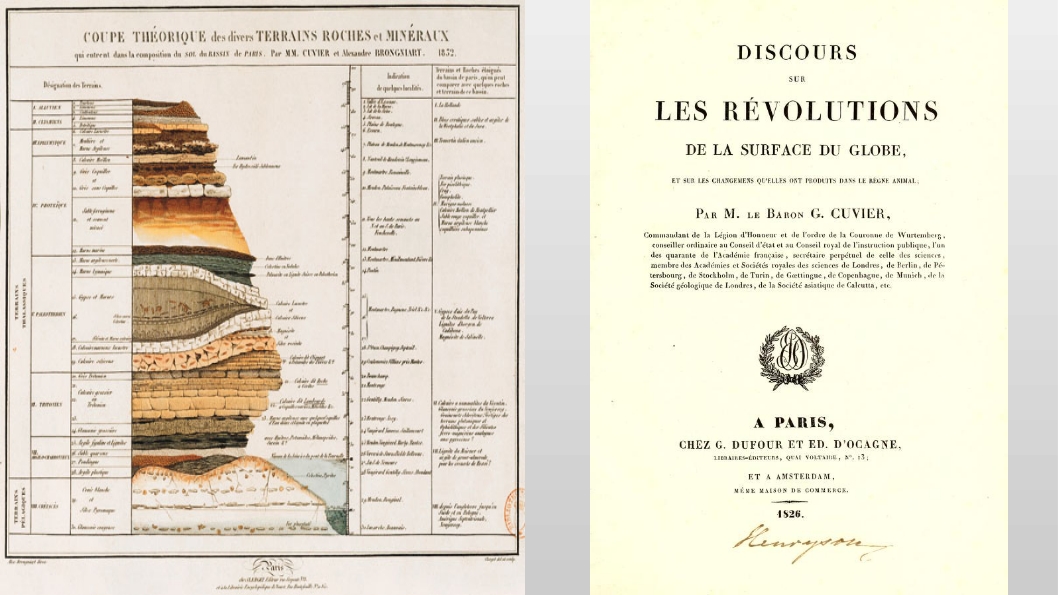
Cuvier’s
theory
of catastrophic
revolutions of the earth
and
the gradualism – ‘natura non facit saltum’ – of Charles
Lyell
and Charles
Darwin,
who argued that the same processes that transformed the earth are
still going on, but our existence is so short that we have difficulty
grasping the implications of geological time scales.
Notice
how Cuvier weaves together human and geological revolutions and
transformations in this opening
passage
from his Essay
on the Theory of the Earth:
If
we are interested in tracing out the nearly effaced vestiges of the
infancy of our species, in so many nations utterly extinct, why
should we not seek to discover, in the obscurity which envelopes the
infancy of the earth, relics of revolutions long anterior to the
existence of all nations? We admire that power of the human mind, the
exercise of which has enabled us to ascertain those motions of the
planets, which Nature seemed for ever to have held from us; genius
and science have soared beyond the limits of space; some
observations, developed by reason, have detected the mechanism of the
world. Would it not be some renown for a man, in like manner, to
penetrate beyond the limits of time, and to discover, by research and
reflection, the history of this world, and of a succession of events
which preceded the birth of the human race?

….When
the traveller passes over those fertile plains here the peaceful
waters preserve, by their regular course, an abundant vegetation, and
the soil of which, crowded by an extensive population, enriched by
flourishing villages, vast cities, and splendid monuments, is never
disturbed but by the ravages of war, or the oppression of despotism,
he is not inclined to believe that nature has there had her intestine
war; and that the surface of the globe has been overthrown by
revolutions and catastrophes; but his opinions change as he begins to
penetrate into that soil at present so peaceful, or as he ascends the
hills which bound the plain; they extend as it were with the
prospect, they begin to comprehend the extent and grandeur of those
events of ages past as soon as he ascends that more elevated chains
of which these hills form the base, or, in following the beds of
those torrents which descend from these chains, he penetrates into
their interior.

in
closely examining what has taken place on the surface of the globe
since it was left dry for the last time, and the continents have
hence assumed their present form; at least in the highest parts, we
clearly see that the last revolution, and consequently the
establishment of present society, cannot be very ancient. It is one
of the results, at the same time the most clearly proved, and the
least regarded in sound geology; a result the more valuable as it
unites, in an unbroken chain, natural and civil history.
– Georges
Cuvier. 1817. Essay on the Theory of the Earth (a. k. a.,
Revolutions of the Earth), p. 8.

The
stratified surface of the earth, just like the strata of societies,
are subject to upheavals, revolutions, and catastrophes. It is not
an acident that the concepts of social stratification and of social
strata come into sociology via Lester Frank Ward, who was both a
sociologist and a geologist.
Ward,
Lester F. 1889. The Geographical Distribution of Fossil Plants.
Washington: Goverment Printing Office.
Ward,
Lester F. 1906. Applied Sociology: A Treatise on the Conscious
Improvement of Society by Society. Boston: Gin & Company.
We
must note that Cuvier was trying to defend creationism and the fixity
of species in the face of his own discovery of the evidence for
extinctions, catastrophes, and long geological eras recording the
history of the Earth. His views dominated Natural History until
Darwin.
[ Aside on Cuvier, Fixity, etc.
]
Darwin
follows Lyell’s gradualism and opposed to Cuvier’s catastrophes,
and so he observes crises not so much in terms of catastrophes and
revolutions of the earth, but in terms of an everyday “struggle for
life/struggle for existence” which he explains in this way:
I
should premise that I use the term Struggle for Existence in a
large and metaphorical sense, including dependence of one being on
another, and including (which is more important) not only the life of
the individual, but success in leaving progeny. Two canine animals
in a time of dearth, may be truly said to struggle with each other
which shall get food and live. But a plant on the edge of a desert
is said to struggle for life against the drought, though more
properly it should be said to be dependent on the moisture. A plant
which annually produces a thousand seeds, of which on an average only
one comes to maturity, may be more truly said to struggle with the
plants of the same and other kinds which already clothe the ground.
The missletoe is dependent on the apple and a few other trees, but
can only in a far-fetched sense be said to struggle with these trees,
for if too many of these parasites grow on the same tree, it will
languish and die. But several seedling missletoes, growing close
together on the same branch, may more truly be said to struggle with
each other. As the missletoe is disseminated by birds, its existence
depends on birds; and it may metaphorically be said to struggle with
other fruit-bearing plants, in order to tempt birds to devour and
thus disseminate its seeds rather than those of other plants. In
these several senses, which pass into each other, I use for
convenience sake the general term of struggle for existence.
-
Darwin. Origin of Species, Chapter III. “Struggle
for Existence.”
One
might also mention in this regard that Darwin and Marx are closer to
each other than Darwin and Cuvier. The crisis in the production,
distribution and consumption within the social relations of Capital,
are, just like the “struggle for existence”, momentary crises of
everyday life. They are not a product of a “spirit of the age”
or a “Spirit of a People (Nation, etc) or even of a some kind of a
“world-picture” which was the term a certain fascist philosopher
of the 20th century used.
I
think Bernstein wants to put his crisis up on a pedestal to support
his vision of culture and the cultured person. So I would agree with
my critic that his declaration of a crisis of 20th century
music is problematic
AND
so is his solution, at least in terms of music, seems in the end to
come down to:
listen
to Stravinsky and Mahler, with some Beatles and Motown thrown in!
Of
course, he takes no notice of Funkadelic, James Brown, or that King
Crimson had already been touring for two years doing the material
that would be released as the trilogy Larks Tongues in Aspic,
Starless and Bible Black, and Red. Henry Cow had been
performing already for 4-5 years by the time Bernstein is lecturing,
just to name some contemporary markers. Robert Fripp and Brian Eno
released No Pussyfooting in 1973, but had performed it live
the year before, Ornette Coleman’s Free Jazz was already 15
years old, John Coltrane and Eric Dolphy had died a decade before,
etc., etc.
Two
years later, Bernstein could have pointed to another contemporary
piece as an example of a “new Crisis”: Brian Eno’s Variation
I on Canon in D Major (1975) with its’ progressive
decomposition/deconstruction of the original
https://www.youtube.com/watch?v=bYCVke7TqlA
as
a marker of a crisis in modernity and music that Bernstein at the
very moment that Bernstein is lecturing. Or maybe not :-)
Let’s
hear the beginning of the original, in case you are not familiar with
it by name (it was once the most popular piece of classical music in
America). After that, the first part of Eno’s Variation I
[Excerpt
from Pacabel’s canon and first part of Eno’s Variation]
How’s
that for your “Crisis in Ambiguity”!
My
critic suggested several works that would be of interest to you.
Zola’s Human Beast and Flaubert’s Madame Bovary
track these social disruptions and Joyce’s Ulysses expresses
the results.
Walter
Benjamin’s essay “On Some Motifs in Baudelaire” describess
Baudelaire seeking “a holistic nature, in the face of industrial
fragmentation” in “The Swan,” and the whole cycle of “Parisian
Scenes”. Apollinaire’s “Zone” captures “the full
domination of modernity….
“‘Second
nature’ also developed by Georg Lukacs…. Martin Heidegger’s
‘The Thing’.… ‘Sacrifice without tragedy’ and Agamben’s
concept of ‘sacred man’ aka ‘bare life’: life that can be
killed without it being considered homicide or sacrifice (such as
Proles toiling in a factory, being maintained in life enough to work
but to barely stay alive)” and all of these should be consulted for
a less American-centric reading than you have heard from me and
I’ve
included these in the bibliography for you.
The
final point is on music and language, and it is here that my critic
and I noticeably disagree. Here is the comment that needs a more
involved response because they are such good and important points for
you to consider:
-The
idea of ‘natural music’ seems to open the question of Cassirer of
‘symbolic forms’ and Panofsky on ‘Perspective as a Symbolic
Form’: is artistic form a natural expression of its historical
context? Bernstein seems to be seeing music as a ‘natural’
emergence from historical conditions. But humans are always in the
‘drive’ (Trieb) (instincts filtered through culture) and
never purely instinctual (Instinkt), biological creatures
(that's Freud and Lacan)
-In
my psychoanalysis classes, I teach that language is distinctly human
(and students always freak out): humans are embedded in the Symbol (a
sign that refers to a whole system of signs in order to have
meaning), whereas animals use sounds as indexical relationships
(meaning dependent upon a specific use in time and space--I use
Peirce and Terence Deacon, and of course Lacan). Music, I have not
thought about...but I would go out on a limb and say that human music
and birdsong is different. The question, how is language different
from music is a tough one. Music always has this sense of being the
expression of some natural animalistic rhythm, but if we are never
totally ‘natura’ creatures, then what?
Well,
here is where I think we part company in significant ways, so I will
try to explain by addressing both comments at once.
I
think that for Bernstein music is related language because both are
natural to humans and, at the same time, they are each a natural
result of the social context. However, I think that Bernstein’s
views of languageare a romanticized reading of Chomsky’s theory.
Whatever one thinks of if, Chomsky’s views are firmly grounded in
rational empiricism. Chomsky certainly argues that language
distinguishes us from all other animals. It is something that we
share with each other, that identifies homo sapiens as a whole, but
he does mean this in terms of biology/neurology/genetics. He now
does say that language acquisition is not “hard-wired” for
language but uses the language of genetics. That is why an chimp can
not really learn English, he says, but that we can take a sentence
like “Colorless green ideas sleep furiously” and sort of make
sense of it even though it is nonsense.
Moreover,
I see Bernstein’s description of music is romanticized, i. e., his
notion that music expresses some sort of natural truth and that this
truth is our own value as humans; that the value of music is its
expression of a crisis around the concept of what it means to be
human.
To
me there is a rather Platonic idea of the poet/artist/orator running
through such romanticized notions. The notion of being “embedded
in Symbol” sounds too metaphysical/theological to an Epicurean like
myself, but that is my ideological bias.
I
don’t mind if one defines language as being uniquely human.
So
long as this does not exhaust the concept of language, I don’t have
much of a problem, and it does leave linguistics solely focused on
human language.
But
this does not make human language particularly interesting, or at
least, no more interesting than the ways other animals communicate
with each other in order to live socially, forage, hunt, mate, etc.
We maybe too limited to communicate with other animals using our
vocalizations (excluding dogs, etc.), this does not mean that other
animals do not also communicate complex information with each other
that is no where encoded in their genes.
Actually,
Darwin argued that music is quite natural to many animals and , not
just humans, that in humans music came before language. For example,
this passage from the Descent of Man:
All
these facts [about the making and expression of musical sounds by
humans and other animals] with respect to music become to a certain
extent intelligible if we may assume that musical tones and rhythm
were used by the half-human progenitors of man, during the season of
courtship, when animals of all kinds are excited by the strongest
passions. In this case, from the deeply-laid principle of inherited
associations, musical tones would be likely to excite in us, in a
vague and indefinite manner, the strong emotions of a long-past age.
Bearing in mind that the males of some quadrumanous animals have
their vocal organs much more developed than in the females, and that
one anthropomorphous species pours forth a whole octave of musical
notes and may be said to sing, the suspicion does not appear
improbable that the progenitors of man, either the males or females,
or both sexes, before they had acquired the power of expressing their
mutual love in articulate language, endeavoured to charm each other
with musical notes and rhythm. So little is known about the use of
the voice by the Quadrumana during the season of love, that we have
hardly any means of judging whether the habit of singing was first
acquired by the male or female progenitors of mankind. Women are
generally thought to possess sweeter voices than men, and as far as
this serves as any guide we may infer that they first acquired
musical powers in order to attract the other sex. But if so, this
must have occurred long ago, before the progenitors of man had become
sufficiently human to treat and value their women merely as useful
slaves. The impassioned orator, bard, or musician, when with his
varied tones and cadences he excites the strongest emotions in his
hearers, little suspects that he uses the same means by which, at an
extremely remote period, his half-human ancestors aroused each
other's ardent passions, during their mutual courtship and rivalry.
Darwin,
C. R. 1871. Descent of Man, and selection in relation to
sex. London: John Murray. Volume 2. 1st edition.
http://darwin-online.org.uk/content/frameset?itemID=F937.2&viewtype=text&pageseq=1


In
terms of whether music and language are instinctual, again I think
this depends on how one defines instinctual. I think that the Darwin
quote addresses this, but also there is the chapter on “Instincts”
from the Origin of Species in which he notes, particularly in
reference to the so-called “instinct for slavery” – which was
claimed to exist in species of slave-making ants and in humans, too.
Indeed, this “instinct for slavery” was used as a scientific
justification for slavery in the American South. Instead, using his
observations of colonies of slave-making ants, Darwin surmised that
this “instinct for slavery” was neither fixed nor the product of
design or creation. In fact, instincts vary within species, not just
between them, and that instincts are malleable and subject to natural
(and sexual) selection. This showed, by the way, that slavery in
humans was not natural, nor are any humans “naturally” slaves or
“slavish”.

As
some degree of variation in instincts under a state of nature, and
the inheritance of such variations, are indispensable for the action
of natural selection, as many instances as possible ought to have
been here given; but want of space prevents me. I can only assert,
that instincts certainly do vary – for instance, the migratory
instinct, both in extent and direction, and in its total loss. So
it is with the nests of birds, which vary partly in dependence on the
situations chosen, and on the nature and temperature of the country
inhabited, but often from causes wholly unknown to us: Audubon has
given several remarkable cases of differences in nests of the same
species in the northern and southern United States. Fear of any
particular enemy is certainly an instinctive quality, as may be seen
in nestling birds, though it is strengthened by experience, and by
the sight of fear of the same enemy in other animals. But fear of
man is slowly acquired, as I have elsewhere shown, by various animals
inhabiting desert islands; and we may see an instance of this, even
in England, in the greater wildness of all our large birds than of
our small birds; for the large birds have been most persecuted by
man. We may safely attribute the greater wildness of our large birds
to this cause; for in uninhabited islands large birds are not more
fearful than small; and the magpie, so wary in England, is tame in
Norway, as is the hooded crow in Egypt.
….Therefore
I can see no difficulty, under changing conditions of life, in
natural selection accumulating slight modifications of instinct to
any extent, in any useful direction. In some cases habit or use and
disuse have probably come into play. I do not pretend that the facts
given in this chapter strengthen in any great degree my theory; but
none of the cases of difficulty, to the best of my judgment,
annihilate it. On the other hand, the fact that instincts are not
always absolutely perfect and are liable to mistakes; – that no
instinct has been produced for the exclusive good of other animals,
but that each animal takes advantage of the instincts of others;
– that the canon in natural history, of ‘natura non facit saltum’
is applicable to instincts as well as to corporeal structure, and is
plainly explicable on the foregoing views, but is otherwise
inexplicable, – all tend to corroborate the theory of natural
selection.
–
Charles Darwin. The Origin of Species, Chapter
III: Instinct.
When
one considers other primate and mammals, birds, and some marine
animals, it seems clear that culture not generated from the outside
to mediate an exchange between the instinctual and the
environment/society. I think that Freud uses instinct as
derived from his medical studies and maybe Haeckel’s reading of
Darwin, though of course I don’t know how Lacan is using the
concept. If we were a graduate department, we could have a PhD
student do a dissertation on this!
And
so it follows that I don’t think that language and music set humans
apart, but rather show the continuity homo sapiens with other
species. My use of Darwin’s quote perhaps shows my own biases.
However, to acknowledge the French, one might consider Olivier
Messian’s use of bird-song in his compositions and his studies of
bird songs, too.
Olivier
Messiaen.
Catalogue
d’oiseaux https://www.youtube.com/watch?v=G6Izpdkjrhk
“Les
orioles” from Des canyons aux étoiles
https://www.youtube.com/watch?v=grJCyW6KZ2A
https://www.allaboutbirds.org/guide/Hooded_Oriole/
Reveil
des oiseaux
https://www.youtube.com/watch?v=sgNeH9_8l0w
Not
to ignore Messiaen's own deep religious devotion verging on
mysticism. I suppose that in many ways, questions about the relation
of language to music, or whether both are unique to humans, are for
me questions originating in the conceits of humans, i. e., in the
starting points of all anthropology and metaphysics.
After
all, THE Symbol is all too often nothing other than a idol (or to use
Marx’s term, a fetish) that subsumes us while offering an escape
from Nature ….
a
Nature that is said to offer nothing better than the way of all
flesh? ;-)
Language, Music, Nature, and Second Nature
I
would push back on this idea of a special place for humans – unless
perhaps in our use our natural endowments of culture, language, and
writing to destroy our own habitat and that of countless others. –
More
specifically on language and music as unique to humans, I would like
to conclude by pointing out these four recent articles:
The
first by Crockford et al. from 2018 titled “Chimpanzee quiet hoo
variants differ according to context” found that chimpanzee’s use
quiet “hoos” when traveling, resting, and while alert for danger
in order to exchange a range of complex information about the
location, health, and intentions of the members of the group: “we
identified three acoustically distinguishable, context-specific hoo
variants. Each call variant requires specific responses from
receivers to avoid breaking up the social unit. We propose that
callers may achieve coordination by using acoustically
distinguishable calls, advertising their own behavioural intentions.”
I’ll
just throw this out there for your consideration, but think about the
analogy of soldiers marching and drilling while singing, or workers
timing their movements to work songs.
It
so happens that a few hours ago a primatologist I follow on Twitter
posted this video of bonobos using “vocal coordination” to
organize a safe crossing of some open grassland. It might give you a
better idea of what is being discussed.
Zanna
Clay
https://twitter.com/zannaclay
I
rediscovered this old vid I made of wild #bonobos crossing the
savannah at MbouMonTour NGO project, DRC. It was my 1st time seeing
wild bonobos, I was so excited. Wonderful to observe their
communication & coordination- as the community emerges from the
grasses #GreatApes
https://twitter.com/zannaclay/status/1255794957941604353
and
here's a juvenile bonobo in the savannah, having a pre-departure
solo-play :) #NkalaCommunity #wildbonobos #MbouMonTour #WWF
https://twitter.com/zannaclay/status/1255802491607883776
p.s.
loudest vocal coordination is at the very beginning, rather cool!
To
provide a comparison with another familiar social mammal, we can look
at the 2013 article By Mazzini and others titled “Wolf Howling Is
Mediated by Relationship Quality Rather Than Underlying Emotional
Stress. Which found that wolfs howl together both to maintain social
cohesion, and that this howling is voluntary, showing that “
control over their vocalizations, using them in flexible ways
mediated by the animal’s understanding of its surrounding social
world”
Mazzini,
Francesco, Simon W. Townsend, Zsófia Virányi, Friederike Range.
2013.
Wolf
Howling Is Mediated by Relationship Quality Rather Than Underlying
Emotional Stress. Current Biology. Volume 23, Issue 17,
P1677-1680, September 09.
DOI: https://doi.org/10.1016/j.cub.2013.06.066
https://www.cell.com/current-biology/fulltext/S0960-9822%2813%2900823-3
While
considerable research has addressed the function of animal
vocalizations, the proximate mechanisms driving call production
remain surprisingly unclear. Vocalizations may be driven by emotions
and the physiological state evoked by changes in the
social-ecological environment [1, 2], or animals may have more
control over their vocalizations, using them in flexible ways
mediated by the animal’s understanding of its surrounding social
world [3, 4]. While both explanations are plausible and neither
excludes the other, to date no study has attempted to experimentally
investigate the influence of both emotional and cognitive factors on
animal vocal usage. We aimed to disentangle the relative contribution
of both mechanisms by examining howling in captive wolves. Using a
separation experiment and by measuring cortisol levels, we
specifically investigated whether howling is a physiological stress
response to group fragmentation [5] and whether it is driven by
social factors, particularly relationship quality [6, 7]. Results
showed that relationship quality between the howler and the leaving
individual better predicted howling than did the current
physiological state. Our findings shed important light on the degree
to which animal vocal production can be considered as voluntary.

Wolf
Conservation Center
@nywolforg https://twitter.com/nywolforg/status/1255458054952214528
In
the third article from the Royal Society, published in 217, Filippi,
P. et al. is titled: “Humans recognize emotional arousal in
vocalizations across all classes of terrestrial vertebrates: evidence
for acoustic universals.” Let me read the short abstract:
Filippi,
P. et al. is titled: “Humans recognize emotional arousal in
vocalizations across all classes of terrestrial vertebrates: evidence
for acoustic universals.” Proc. R. Soc. B284: 20170990.
http://dx.doi.org/10.1098/rspb.2017.0990
Writing
over a century ago, Darwin hypothesized that vocal expression of
emotion dates back to our earliest terrestrial ancestors. If this
hypothesis is true, we should expect to find cross-species acoustic
universals in emotional vocalizations. Studies suggest that acoustic
attributes of aroused vocalizations are shared across many mammalian
species, and that humans can use these attributes to infer emotional
content. But do these acoustic attributes extend to non-mammalian
vertebrates? In this study, we asked human participant so judge the
emotional content of vocalizations of nine vertebrate species
representing three different biological classes—Amphibia, Reptilia
(non-aves and aves) and Mammalia. We found that humans are able to
identify higher levels of arousal in vocalizations across all
species. This result was consistent across different language groups
(English, German and Mandarin native speakers), suggesting that this
ability is biologically rooted in humans. Our findings indicate that
humans use multiple acoustic parameters to infer relative arousal in
vocalizations for each species, but mainly rely on fundamental
frequency and spectral centre of gravity to identify higher arousal
vocalizations across species. These results suggest that fundamental
mechanisms of vocal emotional expression are shared among vertebrates
and could represent a homologous signalling system.

And
the fourth and final article is also from the journal Ecology Letters
and is, I think, also important in giving some context to the other
three. This study, titled “Fear of humans as apex predators has
landscape-scale impacts from mountain lions to mice” by Suraci,
Clinchy et al. found that the very sound of the human voice can have
far reaching disruptions to ecological relations.
Humans
have supplanted large carnivores as apex predators in many systems,
and similarly pervasive impacts may now result from fear of the human
‘super predator’. We conducted a landscape‐scale playback
experiment demonstrating that the sound of humans speaking generates
a landscape of fear with pervasive effects across wildlife
communities. Large carnivores avoided human voices and moved more
cautiously when hearing humans, while medium‐sized carnivores
became more elusive and reduced foraging. Small mammals evidently
benefited, increasing habitat use and foraging. Thus, just the sound
of a predator can have landscape‐scale effects at multiple trophic
levels. Our results indicate that many of the globally observed
impacts on wildlife attributed to anthropogenic activity may be
explained by fear of humans.
Pervasive
fear of humans may also precipitate widespread community-level
changes by disrupting natural predator–prey interactions.
Human-induced antipredator behaviour could compromise top-down
ecosystem regulation by large carnivores (Kuijper et al. 2016) and
limit medium-sized carnivore suppression of small mammals (Leviet al.
2012). (Venter et al. 2016), we suggest that the fear we human ‘super
predators’ inspire, independently of our numerous other impacts on
the natural world, may contribute to widespread restructuring of
wildlife communities.
Justin
P. Suraci, Michael Clinchy, Liana Y. Zanette, and Christopher C.
Wilmers. 2019.
Ecology
Letters.
https://onlinelibrary.wiley.com/doi/full/10.1111/ele.13344
So
be quiet when you are walking in the forest, because the very sound
of your voice is having a disruptive effect.
This
might be a good point to remind you of Bernie Krause’s discussion
of acoustic niche and how that might be useful in explaining what
these researchers found.
Though
I obviously take a very different view of language and music than my
critic or Bernstein, I clearly think this is a fruitful line of
discussion to pursue. I am grateful for the comments and criticisms,
as they led me to further research and explore the questions raised.
It
seems like a good place to end is with a quote from Aldo Leopold that
seems relevant in terms of where I am coming from in thinking about
questions concerning the relation of music, language, nature, and
human nature:
“I
never realized before that the melodies of nature are music only when
played against the undertones of evolutionary history”
(Aldo
Leopold from an unpublished manuscript in the Library of America
collection of his writings, c. 1935).

Cumulative Bibliography of Parts One, Two, and Three of the Lecture-cast.
An * marks those suggested by my critic in Part Three.
Adorno, Theodor. 1973. Philosophy of Modern Music. New York, Seabury Press.
https://login.ezproxy.pratt.edu/login?url=https://search.ebscohost.com/login.aspx?direct=true&db=cat...
Adorno, Theodor. “The Problem of a New Type of Human Being” from The Current of Music.
Adorno, Theodor and Hans Eisler. 1947. Composing for the Films.
Adorno on Music and Popular Protest: https://archive.org/details/RicBrownTheordorAdornoonPopularMusicandProtest
Adorno, Theodor. 1972. “Kultur und Verwaltung” in: Collected Writings Vol. 8, Sociological Writings I,
Frankfurt am Main. Broadcast: 26.07.1959, SWF
location: Baden-Baden, Kunsthalle location manager: Biallowancz.
Adorno, Theodor. 1936. “On Jazz” from Essays on Music. University of California Press.
Adorno, Theodor. 1998. Stravinsky: A Dialectical Portrait. Verso.
Adorno, Theodor. 1956/1969. Aesthetic Theory. University of Minnesota Press.
Adorno, Theodor. Three Short Piano Pieces (1934/1945).
Adorno, Theodor. Three Poems by Theodor Däubler for a Four-Woman a capella Choir. Number 3.
Adorno, Theodor. Two Orchestral Songs from the Unfinished ‘The Treasure of Indian Joe’.
*Agamben, Giorgio. 1998. Homo Sacer: Sovereign Power and Bare Life. Stanford: Standford University Press.
*Apollinaire, Guillaume. 1965. Alcools. Berkeley: University of California Press.
Benjamin, Walter. 2001. Correspondence of Walter Benjamin. Harvard University Press.
Benjamin, Walter. 1929- 1932. Aufklärung für Kinder. http://www.ubu.com/sound/benjamin.html
*Benjamin, Walter. 1968. "Some Motifs in Baudelaire" in Illuminations: Essays and Reflections. New York: Schocken Books.
Bernstein, Leonard. 1958-1972. Young People's Concerts.
https://en.wikipedia.org/wiki/Young_People%27s_Concerts
Bernstein, Leonard. 1973. The Unanswered Question, part 5: The XXth Century Crisis.
https://youtu.be/kPGstQUbpHQ?t=7m42s
Bernstein, Leonard. 1973. The Unanswered Question, part 6: The Poetry of the Earth.
https://youtu.be/OWeQXTnv_xU?t=1s
Bernstein, Leonard. 1981. The Unanswered Question. Harvard University Press; Revised edition
Boulez, Pierre. 2006. Pierre Boulez conducts Stravinsky’s The Rite of Spring (Le Sacre du Printemps). Orchestra Filarmonica della Scala. Milan.
https://www.youtube.com/watch?v=ewyqXI21vp0
Boulez, Pierre. 2019. “Idea, Realization, Craft.” Music Lessons: Lectures at the College de France. Chicago: University of Chicago Press.
https://www.powells.com/book/-9780226672595
Burroughs, William S. (with Phil Proctor). “The Control Machine” from Nova Express:
https://www.youtube.com/watch?v=DlTXyV6S5YM
Burroughs, William S. The Limits of Control [Sections VI, VII, VIII, X]
http://eng7007.pbworks.com/w/page/18931079/BurroughsControl
Cage, John. 4’ 33” A performance by William Marx.
https://www.youtube.com/watch?v=JTEFKFiXSx4
Chomsky, Noam. 1957. Syntactic Structures. Boston: Mouton & Co.
Chomsky, Noam. 1975. Aspects of the Theory of Syntax. Cambridge: MIT Press.
Achbar, Mark and Peter Wintonick. 1992. Manufacturing Consent: Noam Chomsky and the Media. Zeitgeist Video.
Clay, Zanna. 2020. Video of wild bonobos engaging in vocal coordination.
https://twitter.com/zannaclay
Clifton Crais & Pamela Scully. 2009. Sara Baartman and the Hottentot Venus: A Ghost Story and a Biography. Princeton University Press.
Cornell Ornathology Lab. 2020. Hooded Oriole.
https://www.allaboutbirds.org/guide/Hooded_Oriole/
Crockford C, Gruber T, Zuberbühler K. 2018. Chimpanzee quiet hoo variants differ according to context. Royal Society Opensci. 5: 172066. http://dx.doi.org/10.1098/rsos.172066
Cuvier, Georges, and Alex. Brongniart. 1822. Description Geologique des Environs de Paris. Paris: Defour et D'Ocagne.
Curvier, Georges. 1825.
Recherches
sur les Ossemens Fossiles, ou l’on retablit le caracteres de Plussiers
Animaux dont les Revolutions du Globe ont detruit le epeces. Paris: Defour et D'Ocagne.
https://archive.org/details/recherchessurles01cuviuoft/page/n8/mode/2upCurvier, Georges. 1826. Discours sur les Revolutions de la Surface du Globe et sur les changemens qu’elles ont produits dans le Regne Animal. Paris: Defour et D'Ocagne.
Darwin, Charles Robert. 1859. On the Origin of Species by means of Natural Selection, or the Preservation of Favoured Races in the
Struggle for Life. London: Murray.
http://darwin-online.org.uk/content/frameset?itemID=F373&viewtype=image&pageseq=1Darwin, Charles R. 1871. D
escent of Man, and Selection in relation to Sex. London: John Murray. Volume 2. 1st edition.
http://darwin-online.org.uk/content/frameset?itemID=F937.2&viewtype=image&pageseq=1“Caricature group portrait of Charles Darwin and the Crew of the
HMS Beagle”. Watercolor by Augustus Earle of “Quarter Deck of a Man of War on
Diskivery [sic] of interesting Scenes on an Interesting Voyage”. Earle was the first official shipboard artist on the
HMS Beagle, tasked with recording the botany, fossils and other specimens en route.
http://www.sothebys.com/en/auctions/ecatalogue/2014/english-literature-history-childrens-books-illus...Eldredge, Niles and S. J. Gould (1972). “Punctuated equilibria: an alternative to phyletic gradualism” in T.J.M. Schopf, ed., Models in Paleobiology. San Francisco: Freeman Cooper. pp. 82-115. Reprinted in N. Eldredge. Time Frames. Princeton: Princeton Univ. Press, 1985, pp. 193-223.
Ellison, Ralph. 2002. “A Snow of Blizzard Proportions” from
Flying Home and Other Stories. New York: Modern Library.
Ellison, Ralph. 2013.
Living with Music: The Jazz Writings of Ralph Ellison. New York; Modern Library.
Eno, Brian. 1975. Variation I on Canon in D Major (1975) from
Discreet Music.
Fausto-Sterling,
Anne (1995). “Gender, Race, and Nation: The Comparative Anatomy of
‛Hottentot’ Women in Europe, 1815–1817” in Terry, Jennifer and
Jacqueline Urla (Ed.) Deviant Bodies: Critical Perspectives on Difference in Science and Popular Culture, 19–48. Bloomington, Indiana University Press.
Filippi,
P. et al. : “Humans recognize emotional arousal in vocalizations across
all classes of terrestrial vertebrates: evidence for acoustic
universals.”
Proceedings of the Royal Society. B284: 20170990.
http://dx.doi.org/10.1098/rspb.2017.0990Foucault, Michel. 1972.
The Archaeology of Knowledge and the Discourse on Language. New York: Pantheon Books.
Foucault, Michel. 1984. “On the Ways of Writing History” in
Power, edited by James D. Faubion. New York: New Press.
Frazer, James. 1922. “King of the Wood” in
The Golden Bough.
https://archive.org/details/in.gov.ignca.6095/page/n19Gould,
Stephen Jay, & Eldredge, Niles. 1977. “Punctuated equilibria: the
tempo and mode of evolution reconsidered.” Paleobiology 3 (2): 115-151.
Gould, Stephen Jay. 1982. “Punctuated Equilibrium—A Different Way of Seeing.”
New Scientist 94 (Apr. 15): 137-139.
Gould, Stephen Jay. 2002.
The Structure of Evolutionary Theory. Cambridge: Harvard University Press.
*Heidegger,
Martin (referred to in part III as “a certain Fascist philosopher of
the 20th century”). 1930s’/revised 1950s/1971. ‘The Thing’ in
Poetry, Language, Thought. New York: Harper Collins.
Horkheimer, Max. 1947. “The Revolt of Nature” from
The Eclipse Of Reason. New York: Continuum.
https://archive.org/details/in.ernet.dli.2015.59625/page/n7Huber, M. P. 1820.
The Natural History of Ants. London: Longman, Hurst.
Charles
Ives. 1933-1942. Study no. 20 (partial); They are There! (first
take); Four Transcriptions from “Emerson” No. 3 ]. Ives Plays Ives The Complete Recordings of Charles Ives at the Piano, 1933–1943. New World Records.
Ives, Charles. 1908. The Unanswered Question: For Chamber Orchestra (performable also as Chamber Music). New York: Southern Music Publishing.
https://imslp.org/wiki/The_Unanswered_Question_(Ives%2C_Charles)Ives, Charles E. “On the Antipodes” from
Songs.Joyce, James. 1946. “The Dead” from
Dubliners. https://archive.org/details/in.ernet.dli.2015.183214/page/n169*Joyce, James. Ulysses. New York: Random House.
https://archive.org/details/ulyssesjoyc00joycKrause, Bernie. 2015.
Voices of the Wild: Animal Songs, Human Din, and the Call to Save Natural Soundscapes. Yale University Press
Lang, Fritz. 1927.
Metropolis.
Leopold, Aldo. 2013. “Unpublished manuscript, c. 1935” in
A Sand County Almanac and other Writings on Ecology and Conservation. New York: Modern Library.
*Lukacs, Georg. 1968.
History and Class Consciousness. Cambridge: MIT Press.
Luxemburg, Rosa. 1913. The Accumulation of Capital. New York, Monthly Review Press.
https://www.marxists.org/archive/luxemburg/1913/accumulation-capital/index.htmLuxemburg, Rosa. 1915. The Anti-Critique. New York; Monthly Review Press.
https://www.marxists.org/archive/luxemburg/1915/anti-critique/index.htmLuxemburg, Rosa. 1974. “Social Reform or Revolution?” in
Selected Political Writings. New York: Monthly Review Press.
Marquis de Sade. 1791/1965.
The Complete Justine, Philosophy in the Bedroom, and Other Writings. https://archive.org/details/marquisdesadecom00saderichMarx, Karl and Fredreich Engels. 1846.
The German Ideology. https://www.marxists.org/archive/marx/works/1845/german-ideology/Marx. 1867/1990.
Capital: The Critique of Political Economy, vol. 1. Translated by Ben Fowkes. New York: Penguin Classics.
Mazzini,
Francesco, Simon W. Townsend, Zsófia Virányi, Friederike Range. 2013.
“Wolf Howling Is Mediated by Relationship Quality Rather Than Underlying
Emotional Stress”.
Current Biology. Volume 23, Issue 17, P1677-1680, September 09.
https://www.cell.com/current-biology/fulltext/S0960-9822%2813%2900823-3Gregor Mendel. 1866/1901. "Experiments in plant hybridization" trans. by C. T. Druery, and William Bateson.
Journal of the Royal Horticultural Society. 26: 1–32.
Messiaen, Olivier.
Catalogue d’oiseaux. https://www.youtube.com/watch?v=G6IzpdkjrhkMessiaen, Olivier. “Les orioles” from
Des canyons aux étoiles. https://www.youtube.com/watch?v=grJCyW6KZ2AMessiaen, Olivier.
Reveil des oiseaux. https://www.youtube.com/watch?v=sgNeH9_8l0wMonty Python. 1975.
King Arthur and the Holy Grail. Norris, Frank. 1901.
The Octopus: A Story of California. https://archive.org/details/octopus00norr/page/n6 And for fun, as one in the original graphic novel series:
https://archive.org/details/ClassicsIllustrated159TheOctopusPachelbel.
Canon and Gigue in D major. Christopher Hogwood. The Academy of Ancient Music.
*Proust, Marcel. 1992.
In Search of Lost Time. Volume I: Swann’s Way. New York: Modern Library.
https://archive.org/details/MarcelProustSwannsWay/page/n3/mode/2upQureshi, Sadiah (2004). “Displaying Sara Baartman, the ‘Hottentot Venus’”.
History of Science 42:233–257.
http://www.negri-froci-giudei.com/public/pdfs/qureshi-baartman.pdfRossellini, Roberto. 1952.
Europa 51.Satie, Erik.
Douze Petits Chorals (1906-1908) - XII. Choral No 12. 12 Petits chorales: No. 12, Grave. Christiane Oelze, soprano -- Eric Schneider, piano.
Schaffer, John.
New Sounds: Hand-picked music, genre free. 24/7 radio from New York City. https://www.newsounds.org/Suraci,
Justin P., Michael Clinchy, Liana Y. Zanette, and Christopher C.
Wilmers. 2019. “Fear of humans as apex predators has
landscape-scale impacts from mountain lions to mice”.
Ecology Letters.
https://onlinelibrary.wiley.com/doi/full/10.1111/ele.13344Thompson, E. P. 1964.
Making of the English Working Class. New York : Pantheon Books.
https://archive.org/details/makingofenglishw0000thom_p8d1Ward, Lester F. 1889.
The Geographical Distribution of Fossil Plants. Washington: Goverment Printing Office.
Ward, Lester F. 1906.
Applied Sociology: A Treatise on the Conscious Improvement of Society by Society. Boston: Gin & Company.
Webern, Anton.
4 Lieder nach Gedichten von S. George
(1908-9). Christiane Oelze and Eric Schneider. Pierre Boulez
conducts. 1. “Erwachen aus dem tiefsten traumes-schooße”; 2. Kunfttag I; 3. Trauer I; 4. Das lockere saatgefilde lechzet krank.
Webern, Anton. 1927-28.
Symphony Op. 21. Berliner Philharmoniker with Pierre Boulez, conducting.
Williams, Raymond. 1961.
The Long Revolution. Broadview Press.
Wolf Conservation Center.
https://twitter.com/nywolforg/status/1255458054952214528*Zola, Emile. 1890. La Bete Humaine (The Beast Within). Paris: Bibliothèque-Charpentier.
https://archive.org/details/TheMonomaniaclaBeteHumaine/page/n15/mode/2upSee also:
Andreyev, Samuel. The Unanswered Question: Analysis.
https://youtu.be/IEAa_MH0iCw?t=1Andreyev, Samuel. Anton von Webern, explained in 10 minutes.
https://www.youtube.com/watch?v=zt2SJrcIJh4Andreyev, Samuel. Anton von Webern's Drei Lieder, Op. 18: Analysis.
https://youtu.be/IEAa_MH0iCw?t=1Anton Webern's Zwei Lieder, Op. 19: Analysis.
https://www.youtube.com/watch?v=FK1iqTTrphM