Showing posts with label Nietzsche. Show all posts

Thursday, February 2, 2012

Lecture Four: Kafka and the Crisis of the Society of Discipline


Lecture Four: Kafka and the Crisis of the Society of Discipline


_____________________

Reading: Franz Kafka,  In The Penal Colony.
[Updated January 22, 2020] 

So far in our attempts to explain the origins of Cultural Studies we have noted many instances of breaks or discontinuities in its history and geography.  I know that thus far the sheer variety of subjects touched on and the range of references might give the appearance of an unstructured curio cabinet.  There are two reasons for this misleading, though understandable,  appearance.

First, the work of Cultural Studies was very much marginal and always critical, even when its was committed to a particular cause.  This distance from the nodal points of authority is one of the treads of continuity that unites these works, even when direct communication was limited.  Though marginal,  disconnected and often exiled, like “tunnelers through a mountain working at opposite sides of the same mountain with different tools, without even knowing if they are working in each other’s direction” the work of Cultural Studies focused on the same objects of study: authority, everyday life, and the social relations of capital.  These critiques converge because of their attention to these objects.  It should not be surprising that in the middle of the 20th century, many were interested in questions of authority and domination, just as it is not surprising that today, these same issues continue to confront us as terror and the domination of nature.

Second, in terms of this critique of authority in these lectures, we are following a line of critique – and hopefully you have noticed this – a line of critique that is itself a critique of the very ideas of Culture and of history/identity.  We have moved from the critique of Enlightenment and the notions of rational authoritarianism, to Borges and the critique of notions such as the author and the authority of the author, the text, tradition, narrative, and the self.  We find this same critique, as did Borges and Adorno, in the works of Kafka.  We even find writing itself brought into view as an instrument of political violence and terror.   A defining characteristic of the State, as Max Weber pointed out, is that it has a monopoly on the means of violence.

As instruments, authority and terror are also artifacts of a society of discipline from its beginnings to its collapse:  the apparatus of the penal colony and the rambling law courts of Orson Wells and Kafka’s The Trial are both jury rigged and on the verge of a collapse that we, like K., know already happened.

Let’s step back to the moment when the disciplinary society became threatened by its own subjects and successful expansion of the Bourgeoisie.  Recall that famous assertion from the Communist Manifesto that “the history of all hitherto existing society is the history of class struggles.”  Straightforward as this might sound, it is actually rather nuanced: we are speaking of society and society is the history of multiple class struggles, but as to what a class is, that will always remain ambiguous in Marx’s writings and amorphous in reality.  We do know  that Engels amended this statement with a clarifying note to the 1888 English edition of the Communist Manifesto:
“That is, all written history.  In 1847, the prehistory of the social organization existing previous to recorded history, was all but unknown.”
Since the writing of the Manifesto 40 years earlier, the field of Anthropology had become increasingly professionalized and interpreters of Darwin were everywhere.  The work of the anthropologists Hasthausen and Morgan had established a past filed not with savages locked in a struggle of all against all, but a mosaic of primitive communistic societies “everywhere from India to Ireland” and yet they were not societies that used the written word.  To Engels the decisive turn towards civilization was the general use and knowledge of written language. 

So when Marx and Engels wrote that all of the history of society is the written history, they were in fact bringing together society, social conflict, and writing/civilization with the latter playing a central role in both social domination and in the domination of nature.  Indeed in the note Engels refers the reader to his own work The Origin of the Family, Private Property, and the State where he follows Morgan in finding that the “upper stage [of Barbarism] begins with the smelting of iron and passes into civilization with the invention of Alphabetic writing and its use for literary records.  Writing had to become public, rather than a special skill of the aristocracy and priesthoods.  In fact, what separates the writing of civilization from the writing of Barbarism (e.g., runes) is the public consumption of writing and the expansion of readers as well.”

Marx, too, makes the connection between writing and history in The German Ideology, which you will remember from the fragment I already showed you.  Marx observes that the writing of history and the modification of the earth and humans are all closely joined.  So again, we have writing, history, the domination of nature, and the domination of social relations --- which together are themselves a social formation which is never without domination and repression as Freud reminds us in The Future of an Illusion.

In Capital, Marx argues that the history of the transformation from feudalism to Bourgeois society, with its creation of the “free labourer” is “written in the annals of mankind in letters of blood and fire (Capital, vol. I, p.143).  We have heard this before, you might recall, from Sade’s Julliette:

“Into hands stained by the murder of spouses and children, sodomy, killing, prostitution, and infamy, heaven has placed these riches to reward me for such abominations.”

When Benjamin wrote of the horrific beauty of Klee’s Nova Angeles, he was within an already long tradition of critique.  We will hear this echoed in Nietzsche, Freud, and the darker writings of the Frankfurt School.

As the commodity is the crystallization of the accumulated labor time, so too is written history the crystallization of a real human struggle for life.  The past is the accumulation of these struggles or what we can piece together from the accumulated remains, but the writing of the past is the interpretation of the past, and that means that the history of the past is always bound up with the systems of power in the present.

To understand this idea of writing and power, let’s look at this excerpt from Levi-Strauss:
“Writing is a strange thing.  It would seem as if it appearance could not have failed to wreak profound changes in the living conditions of our race, and that these transformations must have been above all intellectual in character.  Once men know how to write, they are enormously more able to keep in being a large body of knowledge.  Writing might, that is to say, be regarded as a form of artificial memory, whose development should be accompanied by a deeper knowledge of the past and, therefore, by a greater ability to organize the present and the future.  Of all the criteria by which people habitually distinguish civilization from barbarism, this should be the one most worth retaining: that certain peoples write and others do not.  The first group can accumulate a body of knowledge that helps it to move ever faster toward the goal that it has assigned to itself; the second is confined within limits hat the memory of individuals can never hope to extend, and it must remain the prisoner of a history worked out from day to day, with neither a clear knowledge of its own origins nor a consecutive idea of what its future should be.

Yet nothing of what we know of writing, or of its role in evolution, can be said to justify this conception.  One of the most creative phases in human history took place with the onset of the neolithic era: agriculture and the domestication of animals are only two of the developments which may be traced to this period.  It must have had behind it thousands of years during which small societies of human beings were noting, experimenting, and passing on to one another the fruits of their knowledge.  The very success of this immense enterprise bears witness to the rigour and the continuity of its preparation, at a time when writing was quite unknown.  If writing first made its appearance between the fourth and third millennium before our era, we must see it not, in any degree, as a conditioning factor in the neolothic revolution, but rather as an already-distant and doubtless indirect result of that revolution.  With what great innovation can it be linked?  Where technique is concerned, architecture alone can be called into question.  Yet the architecture of the Egyptians or the Sumerians was no better than the work of certain American Indians who, at the time America was discovered, were ignorant of writing.  Conversely, between the invention of writing and the birth of modern science, the western world has lived through some five thousand years, during which time the sum of its knowledge has rather gone up and down than known a steady increase.  It has often been remarked that there was no great difference between the life of a Greek or Roman citizen and that of a member of the well-to-do European classes in the Eighteenth century.  In the neolothic age, humanity made immense strides forward without any help from writing; and writing did not save the civilizations of the western world from long periods of stagnation.  Doubtless the scientific expansion of the nineteenth and twentieth centuries could hardly have occurred, had writing not existed.  But this condition, however, necessary, cannot in itself explain that expansion.

If we want to correlate the appearance of writing with certain other characteristics of civilization, we must look elsewhere.  The one phenomenon which has invariably accompanied it is the formation of cities and empires: the integration into a political system, that is to say, of a considerable number of individuals, and the distribution of those individuals into a hierarchy of castes and classes.  Such is, at any rate, the type of development which we find, from Egypt right across to China, at the moment when writing makes its debuts; it seems to favor rather the exploitation than the enlightenment of mankind.  This exploitation made it possible to assemble workpeople by the thousand and set them tasks that taxed them to the limits of their strength: to this, surely, we must attribute the beginnings of architecture as we know it.  If my hypothesis is correct, the primary function of writing, as a means of communication, is to facilitate the enslavement of other human beings.  The use of writing for disinterested ends, and with a view to satisfactions of the mind in the fields either of science or the arts, as a secondary result of its invention – and may even be no more than a way of reinforcing, justifying, or dissimulating its primary function.

There are, however, exceptions to this rule.  Ancient Africa included empires in which several hundred thousand subjects acknowledge a singe rule; in pre-Columbian America, the Inca empire numbered several million subjects.  But, alike in  Africa and in America, these ventures were notable unstable: we know, for instance, that the Inca empire was established in the twelfth century or thereabouts.  Pizarro’s soldiers would never have conquered it so easily if it had not already, three centuries later, been largely decomposed.  And, from the little we know of the ancient history of Africa, we can divine an analogous situation: massive political groups seem to have appeared and disappeared within the space of not many decades.  It may be, therefore, that these instances confirm, instead of refuting, our hypothesis.  Writing may not have sufficed to consolidate human knowledge, but it may well have been indispensable to the establishment of an enduring domination.  To bring the matter nearer to our own time: the European-wide movement towards compulsory education in the nineteenth century went hand in hand with the extension of military service and the systematization of the proletariat.  The struggle against illiteracy is indistinguishable, at times, from the increased powers exerted over the individual citizen by the central authority.  For it is only when everyone can read that Authority can decree that ‘ignorance of the law is no defense’. [Emphasis added.] – Claude Levi-Strauss, Triste Tropiques, pp.291-293.
[Mull that over for a side discussion, but frame those discussions in terms of this dialectical aspect of writing, that it is at once emancipatory and simultaneously an instrument of power.  It would be intellectually dishonest to privilege the one aspect over the other simply because one appeals to our prejudices as academics.]

Levi-Strauss gets at the core of the dialectic in which I am trying to situate Kafka’s writings – and their importance for Cultural Studies: writing as a technique of Enlightenment and terror.

I should remind you again that culture in Cultural Studies consists of the artifacts and techniques of social relations.  It is not about an identification with us by a veneration or valuation one’s elective affinities, nor of promoting either high or popular culture.  Indeed, it is through the analysis and critique of artifacts (commodities and techniques (regulations, laws, social policy, the organization of knowledge, police powers, the State monopoly on violence, etc.) that we can begin to better understand the past and present structure of social relations.

From Sade to Conrad, Frank Norris, and Kafka, the imaginations of some writers of the bourgeois era captured glimpses of the apparatus of power, glimpses that can be directly derived from a critical inquiry into the accumulations of social life.  We will see in Terry Gilliam’s film Brazil that Sam Lowery’s dreams are filled with such glimpses into the real apparatus that he sees --but does not recognize – in everyday life ...... until it is too late.  But then, how could any of these works avoid providing us with these glimpses of what was for them “just the way the world is” and can we come to see our own relations of authority when we are immersed in them?  It is the essence of everyday life that it appears natural, and it is the work of Cultural Studies to de-naturalize the world in order to oppose the domination of nature and humans.  For the choice of the generations your own were as stark as “Socialism or Barbarism”  Let’s hope that yours makes a better choice than mine, if indeed either had or has a choice.

In any event, our recent generations share the experience of terror and the internalization of terror, the naturalizing of it as “just the way the world is” is something that is shared by all in the societies of control.   The difference is that at present the generalized terror has specific local effects, while the doctrine of Mutually Assured Destruction (M.A.D.) was also generalized in its effects.  Under the doctrine of Mutually Assured Destruction one was always terrorized and one still is, except that now the threat we are always being reminded of is the stray bag on the subway, and not global annihilation.  Not that that minor threat has gone away, it is still just present and if anything the threat is greater now than in 1960.  In a sense it has become an adjunct to the global environmental crisis.

During the Cold War, we lived in a state of terror, and the State is a fundamental source of terror.  After all, only States had nuclear weapons and States monopolized the scientific knowledge of modern weaponry.  The State was constantly reminding us to be terrified and of the sensation of terror.  We internalized that terror as M.A.D and now we do the same using WMDs.

When Henri Lefebvre wrote of our “terrorist society’ – as oppose to a merely terrorized society – he argued that this social formation “was first perceived by writers and critics” of the bourgeois era (Lefebvre, Everyday Life in the Modern World, p.143).  Their writings mark the transformation from a society of discipline to a society of control and Kafka’s writings in particular are a mark of this transformation.  If the writers of the bourgeois era had already grasped the extent of the repressive apparatus of Enlightenment Reason (Horkheimer), then we have ample reason to examine their works along side the other ruins.  This is the reason why we turn to Sade, Conrad, Poe, Raymond Chandler, Chester Himes, etc., as well as Kafka and Borges.  The connection between civilization and writing as both recording of history and as a mark of violence is why we must read Kafka’s The Trial and In the Penal Colony into the genealogy of Cultural Studies.

Kafka's Drawings for The Trial
Kafka’s works abound with parables that can stand alone, such as “Before the Law” and stories within stories where we can find the repetition of everyday life – a sense of deja vu or a continual starting over/return to what is already present.  But there are also the repetitions of dreams, fantasies and desires which we find intruding into and breaking off narratives.  In Orson Well’s adaptation of The Trial, this is brought to the fore as K. is constantly distracted by his sexual desires from attending to “his case.”  We will also see this in Gilliam’s Brazil in coming weeks. 

For Adorno, Kafka’s use of deja vu is permanent: 
“...each sentence says ‘interpret me’, and with it the question ‘where have I seen that before?’; the deja vu is declared permanent.  Through the power with which Kafka commands interpretation, he collapses aesthetic distance.  He demands a desperate effort of the allegedly ‘disinterested’ observer of an earlier time, overwhelms him, suggesting that far more than his intellectual equilibrium depends on whether he truly understands; life and death are at stake.” (Adorno, “Kafka” from Prisms, p.246).
As with Borges, the reader becomes actively engaged in the writing of the text; it is the reader who “completes the text.”  Adorno sees that reading Kafka engages the reader into becoming an author.  This active reader has very much like the same importance as the active listener to the New Music from Schoenberg and Webern to Henry Cow and Robert Fripp.  And just as in the New Musics, we find that this active engagement with the text provides the reader with the element of shock that interrupts the routine and the everyday: 
“Among Kafka’s presuppositions, not the least is that the contemplative relation between text and reader is shaken to its very roots.  His texts are designed not to sustain a constant distance between themselves and their victim but rather to agitate his feelings to a point where he fears that the narrative will shoot towards him like a locomotive in a three-dimensional film.” (Adorno, “Kafka” from Prisms, p.246)
Let’s not forget the centrality of dreams in Borges and Kafka. 
Orson Wells characterizes The Trial as “a dream or a nightmare” and opens his film The Trial with K. awakening as though from a dream, or perhaps even drifting off into a dream.  It is the most dangerous time of the day, Kafka wrote in a deleted passage from The Trial.
As someone said to me – I can’t remember now who it was – it is really remarkable that when you wake up in the morning you nearly always find everything in exactly the same place as the evening before.  For when asleep and dreaming you are, apparently as least, in an essentially different state from that of wakefulness; and therefore, as that man truly said, it requires enormous presence of mind or rather quickness of wit, when opening your eyes to seize hold as it were of everything in the room as exactly the same place where you had let it go on the previous evening.  That is why, he said, the moment of waking up was the riskiest moment of the day.  Once that was well over without deflecting you from your orbit, you could take heart of grace for the rest of the day. (Adorno, “Kafka” from Prisms, p.258)
In the film, K. is awakening and bringing the world into focus just as the Officer comes through the door.  In the book, however, K. is already awake and wondering why Mrs. Grubach does not have breakfast ready yet when the routine of everyday life is interrupted and through the interruption the everyday becomes de-naturalized and even takes on a sinister hue.  From then on, every action, even the ringing of the bell for Mrs. Grubach, becomes double sided and confirms his guilt.  It reminds one of the opening to Proust’s Remembrance of Things Past, except that the bourgeois contemplative reveling in his recollections is not a part of The Trial. No, rather it seems to be implied that until his arrest K.’s mornings may have been the mornings typical of a young banker.   K.’s revels are interrupted first by the absence of Mrs. Grubach, then by the surveillance of “the old lady” across the way, by his own ringing of the bell, and finally by the appearance of the Official coming through K.’s door.  He is, after all, hungry, i. e., K. remains a physical being and that is an inescapable reality no matter what the content of our dreams and fantasies.

And as with Borges, dreams become a way to begin understanding Kafka’s writings:
“Cocteau rightly pointed out that the introduction of anything startling in the form of a dream invariably removes its sting.  It was to prevent such misuse that Kafka himself interrupted The Trial at a decisive point with a dream – he published the truly horrifying piece in A Country Doctor – and by contrast confirmed the reality of everything else, even if it should be that dream-reality suggested periodically in The Castle and America by passages so agonizingly drawn out that they leave the reader gasping for air.  Among the moments of shock, not the least results from the fact that Kafka takes dreams a la lettre.  Because everything that does not resemble the dream and its pre-logical logic is excluded, the dream itself is excluded.  It is not the horrible which shocks, but its self-evidence.... The attitude that Kafka assumes towards dreams should be the reader’s towards Kafka.  He should dwell on the incommensurable, opaque details, the blind spots. (Adorno, “Kafka” from Prisms, p.248).
When Josef K. encounters the everyday routines of the Law Offices, he becomes dizzy. The offices are not only dreamlike, but a suffocating interior world – in which his own psyche is made to appear before him alienated and oppressing him.  The distance between his interior and exterior, between his work, the law courts, his office, the artists studio become steadily reduced until they are all just rooms in an immense bureaucratic office.


This collision between the fantasy and the reality of social relations is something that we will see again in Brazil.
In the Penal Colony is a much more concentrated work than The Trial, and better displays the sense of the transition or transformation.  In The Trial, K. has been arrested and his exploration of the apparatus of the Law are from the vantage point of the accused who is already-guilty.  In the Penal Colony, the apparatus is the center of attention, not the accused/convicted, and the Explorer is more the observer from that part of the world which is progressing beyond the disciplinary brutalities of the Apparatus.

The Officer already knows what recommendation the Explorer will write in his letter to the new Commandant.  The Explorer's task is not so much to evaluate the Apparatus, but to witness its demise: 
“I can hear his voice – the ladies call it a voice of thunder – well, and this is what he says:  ‘A famous Western investigator, sent out to study criminal procedure in all the countries of he world, has just said that our old tradition of administering justice is inhumane.  Such a verdict from such a personality makes it impossible for me to countenance these methods any longer.  Therefore from this very day I ordain...’ and so on... and I and the work of the old Commandant will be done for” (p.212).
We have seen this Apparatus at the moment of its very inception in Sade’s apparatuses and machines of pleasure/pain.  We see it again in Wells’ portrayal of the law offices in The Trial and In the Penal Colony, but in both these two instances from Kafka, the Apparatus is crumbling materially and ideologically. 

We could trace out this transformation with this scheme, with the proviso that like all schemes it is by definition simplistic:


Societies of Discipline                Societies of Control
(Terrorized Societies)                (Surveillance and Terror)
-----
The Apparatus                             Power/Knowledge
of violence/pleasure (Sade)        Terror, Desire, Authority

Direct Discipline                     Institutionalized/Internalized Terror
Guilt is assumed                     Guilt must be constantly experienced

Natural Power                          Naturalized state power
of Ruler/Tyrant

Under the disciplinary regimes, punishment was direct.  It was conducted in public and punishment was was a spectacle carried out on the body of the condemned in keeping with the dictates of Reason.  This we certainly touched on in our perusal of Constitutio Criminalis Theresiana .  Relations of power were the result of the naturalized power of the Ruler/Tyrant to judge.

The society of Enlightenment was a disciplinary society, but so too are control societies premised on the same reason and rationality.  They are continuous in their institutions: bureaucracy, the machine, the factory, prison, hospital, school/university, etc.

Under regimes of Control however, discipline is internalized.  One does not need the hand of the police if one simply learns to obey the rules.  And all the better that one willingly accepts a regime than be force to comply with its laws.  The powers that were once represented by the body of the Sovereign were now naturalized as powers of the State and everyday life reproduces those relations.  Josef K. stands between all of these.  His is marginalized.  In terms of a disciplinary regime, his guilt is assumed, but unlike a disciplinary regime, his punishment is postponed.  His guilt must be constantly experienced and yet he demands to be found innocent.  Even as he comes to realize the absurdity of the Law, the same Reason that brought him to that emancipatory moment is also the means by which he internalizes its operations.  In his speech at his first interrogation K. lays out the entire apparatus of power whose existence had, until the moment of his arrest, apparently never bothered him in the least.

“‘What has happened to me,’ K. went on, rather more quietly than before, trying at the same time to read the faces in the first row, which gave his speech a somewhat disconnected effect, ‘what has happened to me is only a single instance and as such of no great importance, especially as I do not take it very seriously, but it is representative of a misguided policy which is being directed against many other people as well.  It is for these that I take up my stand here, not for myself.... ‘There can be no doubt....  – there  can be no doubt that behind all the actions of this court of justice, that is to say in my case, behind my arrest and today’s interrogation, there is a great organization at work.  An organization which not only employs corrupt warders, oafish Inspectors, and Examining Magistrates of whom the best that can be said is that they recognize their own limitations, but also has at its disposal a judicial hierarchy of high, indeed of the highest rank, with an indispensable and numerous retinue of sevants, clerks, police, and other assistants, perhaps even hangmen.  I do not shrink from that word.  And the significance of this great organization, gentlemen?  It consists in this, that innocent persons are accused of guilt, and senseless proceedings are put in motion against them, mostly without effect, it is true, as in my own case.  But considering the senselessness of the whole, how is it possible for the higher ranks to prevent gross corruption in their agents?  It is impossible.  Even the highest Judge in this organization can not resist it.  So the warders try to steal the clothes off the bodies of the people they arrest, the Inspectors break into strange houses, and innocent men, instead of being fairly examined, are humiliated in the presence of public assemblies.  The warders mentioned certain depots where the property of prisoners is kept;  I should like to see these depots where the hard-earned property of arrested men is left to rot, or at least what remains of it after thieving officials have helped themselves” (pp.45-46).
Even at the beginning of his deferred case, the absurdity of it all makes sense to him.  And with his speech, which the Usher’s wife assures him cause quite a stir and set the Examining Magistrate to writing page after page to document his interrogation. 

There is another precursor to Kafka that you may want to consider, for perhaps it is an artifact of the early disciplinary society, just as the In The Penal Colony is of the end of that society.  Compare Kafka’s parable Before the Law, which Wells places as a prologue but which actually occurs during Josef. K.’s encounter with the Priest (the “prison chaplain”), with the brief chapter “The Prison Door” from Nathaniel Hawthorne’s Scarlet Letter:
The Prison Door

A THRONG of bearded men, in sad-colored garments, and gray, steeple-crowned hats, intermixed with women, some wearing hoods and others bareheaded, was assembled in front of a wooden edifice, the door of which was heavily timbered with oak, and studded with iron spikes. The founders of a new colony, whatever Utopia of human virtue and happiness they might originally project, have invariably recognized it among their earliest practical necessities to allot a portion of the virgin soil as a cemetery, and another portion as the site of a prison. In accordance with this rule, it may safely be assumed that the forefathers of Boston had built the first prison-house somewhere in the vicinity of Cornhill, almost as seasonably as they marked out the first burial-ground, on Isaac Johnson's lot, and round about his grave, which subsequently became the nucleus of all the congregated sepulchers in the old churchyard of King's Chapel. Certain it is, that, some fifteen or twenty years after the settlement of the town, the wooden jail was already marked with weather - stains and other indications of age, which gave a yet darker aspect to its beetle-browed and gloomy front. The rust on the ponderous iron-work of its oaken door looked more antique than anything else in the New World. Like all that pertains to crime, it seemed never to have known a youthful era. Before this ugly edifice, and between it and the wheel track of the street, was a grass-plot, much overgrown with burdock, pigweed, apple-peru, and such unsightly vegetation, which evidently found something congenial in the soil that had so early borne the black flower of civilized society, a prison. But, on one side of the portal, and rooted almost at the threshold, was a wild rosebush, covered, in this month of June, with its delicate gems, which might be imagined to offer their fragrance and fragile beauty to the prisoner as he went in, and to the condemned criminal as he came forth to his doom, in token that the deep heart of Nature could pity and be kind to him.

 *****
The Apparatus
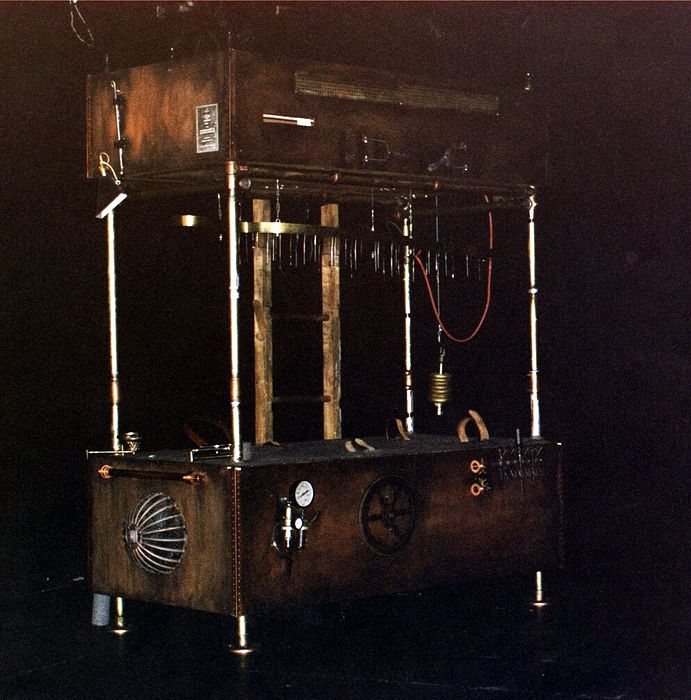
http://grupthink.com/answer/109529/In_the_Penal_Colony_-_Franz_Kafka


“‘It’s a remarkable piece of apparatus’ said the Officer to the Explorer.... The machinery should go on working continuously for twelve hours’” (p.191).   A glimpse of the camps, perhaps, in that the machinery operated continuously, but the camps had not yet been constructed.  The Officer wants to explain the apparatus, but, Kafka tells us, “the Explorer did not much care about the apparatus” (p.191) and displayed a “visible indifference” to it, at least at first.   The Explorer is not alone in this indifference.  No one is interested in the execution of a soldier condemned for “disobedience and insulting behavior to a superior” -- which seems like a serious crime until Kafka reveals the absurdity of the orders the soldier had been given.  Where once the spectacle of the execution – you see it in Westerns, for example – was the demonstration of authority, now that authority permeated everyday life and so there was no longer the need for a special demonstration of violence.  The executions no longer drew the crowds.  Even the residents of the colony had grown indifferent to the continuous executions. 

There is a new Commandant who is not approving of the workings of the apparatus, but has not choice but to allow it to continue, at least for now.  The apparatus and the colony share their origin in the head of the dead Commandant:
“‘This apparatus,’ he said, taking hold of a crank handle and leaning against it, ‘it was invented by our former Commandant.  I assisted at the very earliest experiments and had a share in all the work until its completion.  But the credit of inventing it belongs to him alone... Well, it isn’t saying much if I tell you that the organization of the whole penal colony is his work.  We who were his friends knew even before  he died that the organization of the colony was so perfect that his successor, even with a thousand schemes in his head, would find it impossible to alter anything, at least for many years to come and our prophesy has come true’” (p.193).
The officer refers to it as a machine: “let’s have a look at this machine” (p.192)
We are not really given a description of the Penal Colony.  We learn something of its geography, but we learn much more about the Apparatus.  (Perhaps the Apparatus is the Penal Colony and vise versa) We learn that it is located in “a small valley, a deep hollow surrounded on all sides by naked crags” (p.191).   We also learn that the officer’s uniform was made for the cooler climate of the imperial center and so is “too heavy for the tropics” (p.192).  The Apparatus is outside and seemingly exposed to the elements, but its decline is not blamed on the weather.  In fact, the Explorer twice has to shade his eyes from the bright sunlight.  Kafka writes that the Apparatus is “a huge affair” and yet the Bed and the Designer are the same size, “like two dark wooden chests” with “the Designer hung about two meters over the Bed; each of them bound at the corners with four rods of brass that almost flashed out rays of sunlight.  Between the chests shuttled the Harrow on a ribbon of steel” (p.195). Though "a huge affair" it can accommodate only one prisoner at a time.

We’ve encounter an unstable space where the colony is both on the periphery and at the center, where the Apparatus is the size of one person and as infinite as the Penal Colony itself.  Not unlike the map described in Borges’ poem “On Scientific Rigor” that we perused last time.  The penal colony is literally an enclosure/prison island for those cast off from the community (Nietzsche, Genealogy of Morals).

Even as he extolls the timelessness of the Apparatus, the Officer is constantly adjusting it.  The cogwheel that is making too much noise particular irks him: “one of the cog wheels is the Designer is badly worn; it creaks a lot when it is working; you can hardly hear yourself speak; spare parts, unfortunately, are difficult to get here.”  It is greasy and oily, as evidenced by the Officer’s need to wash his hands.  Like the Law Courts, the Apparatus is obviously breaking down.

The Apparatus “consists... of three parts.  In the course of time each of these parts has acquired a kind of popular nickname.  The lower one is called the ‘Bed,’ the upper one the ‘Designer,’ and this one here in the middle that moves up and down is called the ‘Harrow’” (pg.193).  In the past “a few things still had to be set by hand, but from this moment it works by itself” (p.192)

The Bed is completely covered with a layer of cotton wool and has straps for the wrists, ankles, and neck of the condemned, who is forced to lay face-down.  There is a special gag of cotton wool “to prevent his screaming and biting his tongue” (p.195).  In a measure of mercy or to increase the torment, “an electrically heated basin” (p.202) of gruel is available to the condemned during "the execution of the sentence."

Cotton Wool or raw cotton.

Let’s turn to the text:
“Both the Bed and the Designer have an electric battery.  The Bed needs one for itself, the Designer for the Harrow.  As soon as the man is strapped down, the Bed is set in motion.  It quivers in minute very rapid vibrations, both from side to side and up and down.  You may have seen a similar apparatus in hospitals[*] but in our Bed the movements are all precisely calculated, you see, they have to correspond very exactly to the movement of the Harrow.  And the Harrow is the instrument for the actual execution of the sentence” (pp.195-1960).
(* This may be a reference to the contemporary “Induced Rhythmic Motion” therapy which used vibrating hospital beds.
They are now marketed as “Toning Beds.”  )

Running short of time – just as we are! – the Officer promises to fill in the details tomorrow, but for the moment, he gives only the essentials of the disciplinary technology of government.
“When the man lies down on the bed and it begins to vibrate, the Harrow is lowered onto his body.  It regulates itself automatically so that the needles barely touch his skin.  Once contact is made the steel ribbon stiffens immediately into a rigid band.  And then the performance begins.  An ignorant onlooker would see no difference between one punishment and another.  The Harrow appears to do its work with uniform regularity.  As it quivers, its points pierce the skin of the body whish is itself quivering from the vibration of the Bed.  So that the actual progress of the sentence can be watched, the Harrow is made of glass.  Getting the needles fixed in the glass was a technical problem, but after many experiments we overcame the difficulty.  No trouble was too great for us to take, you see.  And now anyone can look through the glass and watch the inscription taking form on the body.... there are two kinds of needles arranged in multiple patterns.  Each long needle has a short one beside it.  The long needle does the writing and the short needle sprays a jet of water to wash away the blood and keep the inscription clear” (p.200).
And the blood and water flow down open drains into the pit below the Apparatus.

But what is most important is not the machine, but the inscription – the Sentence – that it will be written on the body of the condemned.  “How does the sentence run?” asked the Explorer (p.196).  The Officer’s reply is instructive and leads us to consider not only the machinery of punishment, but also the machinery of the law:  “Our sentence does not sound so severe.  Whatever commandment the prisoner has disobeyed is written upon his body by the Harrow” (p.197).... the most important thing.... In the Designer are all the cogwheels that control the movements of the Harrow, and this machine is regulated according to the inscription demanded by the sentence” (p.202).

Here is an example of a harrow, in case you are not familiar with the device:

The Explorer is allowed to see the inscription – the document is too fragile for anyone other than the Officer to risk touching and he tells the Explorer that “the script itself runs round the body only in a narrow girdle; the rest of the body is reserved for the embellishments...” (pp.202-203). 

What the Explorer sees is “no calligraphy for school children....”  it is – and we can almost hear Borges’ laughter – “a labyrinth of lines crossing and recrossing each other which covered the paper so thickly that it was difficult to discern the blank spaces between them” (p.202).

The Apparatus is a writing machine, a guide, a bed, and a machine operating in accordance with and reproducing the rules/plan/design of the dead Commandant.

Government and writing, knowledge and power are inseparably intertwined with each other.  The violence of governing populations and territories is inseparable from writing (and statistics as well!).  What is it that bureaucracies do that is not connected with writing and calculation?

What makes Kafka's work so frightening is his critique of the everyday.  “It is not the horror that shocks, but its self-evidence” (Adorno, “Kafka” from Prisms, p.248).  The fact, one might say, that we knew all along and yet chose not to know.  Of course, the disciplinary societies were in crisis and collapsed along with the disappearance of their conditions for existence:  conditions such as imperialism, colonialism, urbanization and industrialization, Fordism, and the domination of Nature.  We can in hindsight say look back on the collapse of the disciplinary societies and say “Well, of course!  The impending collapse of such a brutal social system was obvious!”  One day the same will be said of our systems of social relations.  “Well, of course!”

Social systems are inherently unstable and finite in time.  To put that another way, to put it positively, is to acknowledge the concept of social change.  We can argue about the causes, mechanisms, and results of changes in human social relations.  But what we can’t do is deny that social change is a reality of human existence.  History is in fact the narrative we construct of these accumulated and sometimes violent social transformations.  It is not true, though it is about Truth, and it is limited, for if it contained the writing of all of the past, we would only find ourselves in amongst the stacks of Borges' Library of Babel.

So Kafka captures one of these moments: the transformation from a disciplinary society to a new society of control.  He does so through a ruthless undermining and de-naturalizing of the everyday.  He also does it with a wry humor and laughter at absurdity that is captured nicely by in Orson Wells’ retelling.    He is one of the writers of the bourgeois era that, from his rather marginal social position, illuminated the decline of  a social world and the social movement towards a different, though not necessarily better society.  Just because there is social change does not imply that this change is for the better.  One can quite easily have a notion of social change without having a notion of social progress, but one can not have an idea of progress without accepting social change.. 

If you want one final marker of the collapse of disciplinary societies and one that displays the indeterminacy of social change, have a look at Fritz Lang’s M.  which presents a disciplinary society at its end, and it is an end that leads to a choice between authoritarianisms.  This is further announced in Lang’s Metropolis with the handshake of reconciliation between labor and capital under the watching eye of the demigod.  Whose to say that the android wasn’t in the end an authentic replica? 

Let’s conclude on this note.  Marx demonstrated that increased cooperation brings with it material benefits, including increased skill, knowledge, and division of labor.  But that this greater cooperation also brings with it increased surveillance, control of social production, and affirmation of the technological domination of nature and humans.

The new society operates on the body in new ways.  It does not need to punish when the status quo becomes naturalized, where our dreams and fantasies are no less a part of the reproduction of everyday life than is our entertainment.... but the old technologies of discipline kept at the ready... just in case.  In the Penal Colony no one comes to witness the spectacle of execution anymore.  There were once large crowds and immense spectacles of discipline, but now come down to four mere lonely figures.  Compare these to the final scenes of Hawthorne’s Scarlet Letter.  The crowd that is so important to those scenes as the sentence is inscribed on the dying is absent from the Penal Colony.  No one cares anymore.  The Disciplinary Society is already receding into the past, leaving behind broken machines, derelicts towns, and abandoned guards with useless prisoners.  Once, the Officer laments,
“...the assembled company – no high official dared to absent himself – arranged itself around the machine; this pile of cane chairs is a miserable survival from that epoch.  The machine was freshly cleaned and glittering.  I got new spare parts for almost every execution.  Before hundreds of spectators – all of them standing tiptoe as far as the heights there – the condemned man was laid under the Harrow by the Commandant himself.  What is left today for a common soldier to do was then my task, the task of the presiding judge, and was an honor for me.  And then the execution began!  No discordant noise spoilt the working of the machine.  Many did not care to watch it but lay with closed eyes in the sand; they all knew:  Now Justice is being done.  In the silence once heard nothing but the condemned man’s sighs, half muffled by the felt gag.  Nowadays the machine can no longer wring from anyone a sign louder than the felt gag can stifle....” (p.209).
The Explorer and the New (and unseen) Commandant do not overtly destroy the Apparatus, they simply allow it to run its course and fall to pieces.  No doubt the tortures and  punishments remain useful to the new Commandant and many aspects of the previous apparatus, particularly the violence of writing, will be incorporated into the one that the Explorer flees towards.  While fleeing the punishments of the past Apparatus, he is in fact also fleeing towards a new Apparatus that we will call, for the sake of argument, the Society of Control.

As the Explorer says to the Officer:
“You overestimate my influence; the Commandant has read my letters of recommendation, he knows that I am no expert in criminal procedure.  If I were to give an opinion, it would be as a private individual, an opinion no more influential than that of the Commandant, who, I am given to understand, has very extensive powers in this penal colony.  If his attitude to your procedure is as definitely hostile as you believe, then I fear the end of your tradition is at hand, even without any humble assistance from me” (p.212).


Next Lecture: 
Degeneracy, Culture, and Critique

Friday, January 27, 2012

Lecture Two: The Dialectic of Enlightenment I – Bach, Kant, Theresiana, Frederick, Sade, Horkheimer/Adorno


Lecture Two

The Dialectic of Enlightenment I – Bach, Kant, Theresiana, Frederick, Sade, Horkheimer/Adorno  [DRAFT]


_____________________
Reading:
Immanuel Kant. “What is Enlightenment?” http://www.fordham.edu/halsall/mod/kant-whatis.html

Peruse:
Max Horkheimer and Theodor Adorno, “Juliette or Enlightenment and Morality,” pgs.81-119.


Last time we looked a bit at the some misconceptions about Cultural Studies and also mentioned the origins of Cultural Studies. Today we will begin to examine some of the tendencies that came together as Cultural Studies. This means that we must first examine the ideology of enlightenment.

Now we can turn first to the idea of Enlightenment and the era of Enlightenment because it is really the foundation of our time as well as the ideology that is often critiqued in Cultural Studies. It is important to understand that critique does not mean here what it means in the studio. Broadly speaking, the idea of critique is not about simply passing judgment. It is not about good or bad, it is about understanding how ideas and things work, the social determinations of interpretation and following through the implications of their social function, i.e., working out their internal Rationality to its logical conclusions. Don’t misunderstand, it is impossible to be detached and non-judgmental, i. e., objective, and thus by critique we mean deferring judgment rather than immediately passing judgment. On another level, critique demands a self-referential act, and it demands that we must ruthlessly critique our own assumptions as we critique the ideologies and technologies of our social relations. There are real differences between critique and criticism. Too often the two become confused or are taken to mean the same thing, but critique as we mean it has much more in common with Max Weber’s concept of understanding in sociology than it does the work of the critic, or the writer of “consumer and entertainment guides,” or of an advocate for a politics who never questions their own politics. It is about, as Karl Marx said, the ruthless critique of all existing things, the taking apart of the apparatus of everyday life to understand how it is that we come to constantly reproduce that apparatus of life.

Let’s begin approaching Enlightenment by remembering that it has to common meanings: first refers to the ‘era of Enlightenment” and 2] the process of social and individual enlightenment. And remembering this, let’s begin with a bit of music, Bach’s Musical Offering from 1748.

Bach, and his manuscript for the 6 Voice Fugue http://upload.wikimedia.org/wikipedia/commons/2/25/Kdf2.jpg

Here is Das Musikalische Opfer BWV 1079 (The Musical Offering) performed by Le Concert des Nations conducted by Jordi Savall.


While it is a famous piece and you have no doubt heard it before even if you did not realize what you were hearing; it is also very much the music of the Enlightenment. I say this even though Bach is already being shoved to the side by more secular and entertaining popular and court music (e.g., Bach’s own son, C. P. E. Bach, Mozart, Beethoven, and a lot of others in between).

C. P. E. Bach was a court composer for Frederick II (“the Great”) of Prussia (C.P.E. Bach: Concerto pour cello en la majeur, Ensemble Baroque de Limoges Christophe Coin, direction et Cello solo http://www.youtube.com/watch?v=WnVwrArUjYM] In 1747, the elderly church musician visited his son at the Potsdam palace. Frederick, a musician, friend of Voltaire, and social reformer in the Enlightenment mode, had just acquired a new instrument, a pianoforte, the forerunner of the modern piano. Showing Bach the new instrument, and knowing of Bach’s reputation for improvisation, Frederick played a theme and “asked” Bach to improvise a fugue on it. Bach did but when told to improvise a 6 voice fugue, he politely asked to be able to write it down. He did and along with other canons and fugues it is what we know as the Musical Offering. It is an offering to the Emperor and the 6 voice fugue (“ricercar” an early term for fugue and one still used in Bach’s day) was referred to by Bach as the “Prussian Fugue.”


Bach meets Frederick the Great

Much like several of his other compositions, such as the Art of the Fugue, Bach does not specify what instrument is to be used the performance, and so we have a good number of versions of the Musical Offering such as this one orchestrated by Anton Webern and scored for small orchestra by Anton Webern, the 20th Century composer whose work --- along with that of Alban Berg and Arnold Schoenberg --- will constitute “Modern”music and become important for understanding the perspective of the Critical Theory of the Frankfurt School on popular culture and ideology.


J.S. Bach: Musical Offering, BWV 1079 (Orch. Anton Webern) - 
Fuga (Ricercata) a 6 voci · Berliner Philharmoniker · Pierre Boulez.

Adorno noted that Bach deliberately failed to suggest instrumentation for many of his most important and later works so as to not limit them by the musical technology of his day and also to leave them open to future interpretation -- and the makes perfect sense for such a master of improvisation. But we will touch on these things at a later time. For now, listen to Webern’s transcription. Notice how the theme is handed between the different instruments. Listening to this, we have the music of Enlightenment at the moment when Enlightenment was already approaching its limit. The complex interaction of the musicians and the theme is not unlike the complexity that we face when trying to lay out a genealogy for Cultural Studies. When we look closely at, say the shift to the study of popular culture, it will appear as a seemingly natural unfolding of a process of research, as just one thing leading to another, but seen from a broader perspective, what looked simple will seem to be the result of a chaotic and indeterminate interaction of social and natural forces... and sometimes “mere” chance. It is the difference between trying to follow the theme in the Five Movements for String Quartet by Webern: http://www.youtube.com/watch?v=HUKM19Oh3d0 and the hook lines of modern “adult contemporary music.”


Penderecki String Quartet. Webern. Five Movements for String Quartet: Movements: 1. Heftig bewegt 2. Sehr langsam
Movements: 3. Sehr bewegt 4. Sehr langsam 5. In zarter bewegung https://youtu.be/C6kFzeZBrds


Webern’s music also emphasizes the importance of silence, or rather a quiet that allows Nature to be heard. It reminds the listener that what is not heard in the music, and in the past, is just as important as what is heard and known. A great deal of our work is in revealing what has been forgotten and lost in the constant work of authority to repress and silence the basis of the present, to naturalize it while assuring us that we are making progress towards the common goal of an enlightened society.

So what is the meaning of Enlightenment? Dare to be Wise! It is as much about an orientation to the world as it is a time period. The Age of Enlightenment had not yet come, Kant wrote, but it was possible to see its' approach in an era where enlightenment had finally become possible. The essay “What is Enlightenment?” is one of the definitive statements on enlightenment and one that you will encounter in many of your readings and in other courses. If you have already discussed it elsewhere, I think that we can perhaps amplify those discussions or perhaps point out some things that might not have been mentioned yet.

Of course, Kant begins with a definition: Enlightenment is the freeing of Man from tutelage or immaturity. And Enlightenment has a motto: Dare to be Wise! or “Have the courage to use your own reason!” Dare to think for yourself, but also dare to be a Wise Man or a Scholar who uses Reason and Philosophy to develop himself (yes, the gendered language is deliberate for that was what they meant. To them, civil society was the domain of men.)

Although we have been freed from the direction of Nature, most of us still live “under life-long tutelage” and so it is easy for some to present themselves as our guardians, as populists..... as they become tyrants. Of course, this means that most of us live under tyranny. To understand this, he suggests we think about how very attractive its to live at the direction of others --- to just do as you are told. And culture itself makes it even more attractive and easier to give one's self over to another:
“If I have a book which understands for me, a physician who decided for my diet, and so forth, I need not trouble myself.”
And in an interesting acknowledgment of how the social relations of capital are very much under consideration:
“I need not think because, so long as I can pay” others willingly take up the task for me.
There are also the guardians, a special class who understand that freedom is dangerous for the common person, and who have “so kindly assumed superintendence over” those who will not think for themselves.

These guardians have trained and treated us like domesticated cattle, and we have become “placid creatures” who “[w]ill not dare take a single step without the harness...”

Most of us will not attempt to free ourselves because of the difficulty of being Enlightened. Enlightenment does not happen all at once, nor does it happen without struggle. It is our fear of initial failures that leads most of us to fall back into the arms of supervision and authority. Being supervised has become, he writes, almost our very nature. But Kant does not think that it is our real nature, which he sees as being free, and he believes that this fear of using our own reason leads us to the kind of supervision and prejudices that result in war. Don't forget, for despite his faults Kant is all about establishing the basis for world peace and individual dignity through the use of Reason.

But it is very difficult for any single individual to break free from supervision. “He has come to be fond of this state” of living under tyranny and besides, in a world in which one is only allowed to think in the laws and formulas of the guardians, the individual never has an opportunity to use her own reason. And even if one had the courage to think, one would not know what to think, since abandoning tutelage is to abandon the familiar ways of making sense of the world.

In an ironic sense, to those still satisfied living under tutelage the free thinker would appear as irrational, not rational. Sort of like a bunch of bourgeois guys in 1776 Philadelphia telling one of the “Great Kings” of Europe that they are free to think for themselves and to start their own nation. It must be remembered that amongst the “Founding Fathers” were prominent enlightenment figures, such as Franklin and Jefferson.  Jefferson’s interests lay not so much in politics as in Natural History, astronomy, farming, and ethics. His one book is a work of Natural History entitled Notes on the State of Virginia and he was engaged with von Humboldt and Buffon. He was one of the first in the Americas to use the Linnean classification scheme. The Jefferson Bible is well worth a look, as he took the New Testament and removed all of the religious portions, leaving a Christ that is not divine but rather a teacher of ethical living reminiscent of Xenophon’s portrayal of Socrates. (I leave it to you to look that reference up!  Here is Jefferson's Bible: http://americanhistory.si.edu/JeffersonBible/the-book/ 

The Declaration of Independence is perhaps the most radical text of Enlightenment ideology with its almost unheard of declaration of an individual's inalienable rights. It goes far beyond anything that Kant could support. Rather than respecting the ruler/authority, Jefferson et al. assert that if any ruler no longer respects those inalienable rights (and they lay out in detail the wrongs suffered by “the People”), “the People” have not just a natural right but an absolute obligation to throw off that ruler and take power for themselves.

Yes, before you say, “but he was a slaver” let me say it first! ( http://www.nytimes.com/2012/01/27/arts/design/smithsonian-and-monticello-exhibitions-on-jeffersons-slaves.html?_r=1&ref=arts )
However, just as we find in the present day, deeply flawed people are the norm in history and history has been made by deeply flawed people who did not always know what they were doing or even that they were doing it. This is indeed a relativistic stance and I know that relativism and the deferring of judgment may make many uncomfortable, especially if you believe that there are natural codes of behavior or divinely proscribed commandments. However, if, like Diogenes the Cynic you are searching for purity in the past you will be as disappointed as he would be looking for it in the present.
“It is moral certainty, not tentativeness, that historically has encouraged people to harm or kill others. Genocide, racial and religious persecution, and the rest of the long catalog of political acts that have stained human history can only come from people who are sure that they are right. Only in bad novels and comic books do characters knowingly do evil and boast of it. In life, people rationalize their actions in moral terms...” (Edelman, Constructing the Political Spectacle, 1988:5).
This is certainly no less true for ourselves as it is for Jefferson and so many others. It is worth noting that Kant's “What is Enlightenment?” was published in 1784. Mozart dies in 1791. You know the significant dates in North America at that time.

Anyway, Kant thinks that only a few succeed in breaking free on their own.  Obviously, too, there are lots of possible references back to Plato's cave in the Republic. Although individuals might become enlightened, society can not merely because of these few individuals.

This constraint on enlightenment is overcome by shifting our view away from seeing enlightenment as an individual phenomenon to Enlightenment as a social phenomenon: The Enlightenment of a Public.

This public will throw off the guardians only after a period wherein the public learns to use Reason in the governing of itself, and individuals learn the public use of reason and the obligation/debts of self-discipline. During this time, the public is no doubt susceptible to the prejudices instilled in them over the long period of supervision. They might even turn on the former guardians and inflict the same types of domination that was inflicted on them. “Thus the public can only slowly attain enlightenment” but without freedom, Enlightenment of the public is impossible.

In other words, we must learn to be free and oddly enough we can only do this by restricting our freedom until we learn to use it wisely (rationally).

To Kant --- surrounded by revolutions and the social unrest that can lead to revolution --- most revolutions do not fundamentally change our ideologies and ways of life. It is true that they get rid of despots, but more often one despot simply replaces another:  “new prejudices will serve just as well as old ones to harness the great unthinking masses.” An actual social revolution changes our way of thinking and not just who our leaders are 

We need freedom, he says, but what do we mean by this? Well, it is the freedom to “make the public use of one's reason at every point.” ------ the right to argue with each other, to criticize. It is precisely this freedom that is repressed and this repression preventing the progress of enlightenment.
“But in reality, we hear from corner of society the order ‘Do not argue!’”
Now Kant presents us with four figures from his society that specifically issue this command. They are for us representations of the apparatus of authority during his day: the military, the state bureaucracy, the Church, and the Prince/Tyrant/Leviathan.
First, there is the military officer who says 'Do not argue, but drill!'
Second, the tax collector [who says] 'Do not argue, but pay!'
Third, the Cleric [who says] 'Do not Argue, but believe!'
And there is a fourth one, too, the Prince who says 'Do not argue, but obey!' However, it just so happens that Kant's uniquely Enlightened emperor, Frederick the Great, says “Argue as much as you like, and about what you like, but obey!”

Still, we are left with these four figures of authority:
      Officer
      Tax collector
      Cleric
      Tyrant

and their four commands:
       Drill
       Pay our taxes
       Believe
       Obey

We can not be totally free or ‘go back to nature,’ nor would we want such a return. You have heard the phrase, no doubt, "the wise restraints that make men free” and note its' context as it was coined during the 1930s for the Harvard Law School commencement: “You are ready to aid in the shaping and application of those wise restraints that make men free.” It is not as if the relation between authority/government and knowledge is some secret.

Instead, one hears in this famous dictum the implicit idea that free men are restrained, controlled.... that they must repress a part of themselves in order to be free.

And so if we must have these restrictions, then we must distinguish between those that promote Enlightenment and those that create obstacles to Enlightenment.

And to make this distinction, Kant identifies two modes of Reason, one that is a restricted or private/civil reason as opposed to the public use of reason. This public use of freedom is critical of authority and should therefore be free if the public is to be educated: “The public use of one's reason must always be free, and it alone can bring about enlightenment among men.”

The measure of this freedom is to be found in the existence of a new social representative: the Scholar or the learned/wise man. This person uses Reason when he expresses himself in public as “like a scholar before the reading public.” The enlightened individual acting as a citizen expresses himself as a scholar when critiquing an order, a tax, a belief, or the judgment of the authorities, just as his enlightenment is expressed by his obedience.

If left to ourselves and in freedom, Kant argues, we would become enlightened. It is our nature to become so, but we have created structures that both prevent and encourage enlightenment. Moreover, we can’t be left to alone for we are social animals. Laws, regulations, and restrictions on how one carries out their duties in public office, civil society/business, or private affairs are necessary because, if for no other reason, social labor must be organized and rationally carried out. We can debate how to carry out an industrial/military/civil process both before and after we perform it........ but when it is being performed, we must do our duty.
“The touchstone of everything that can be concluded as a law for a people lies in the question whether the people could have imposed such a law on itself.... and what a people may not decree for itself can even less be decreed for them by a Monarch or tyrant....Men work themselves gradually out of barbarity if only intentional artifices are not made to hold them in it.”
This free thinking effects the “character of the people” who as a result gradually become capable of self-government because this freedom promotes “the principles of government” itself. So that government comes to treat humans in accordance with their dignity, and not as machines or instruments of production (as in Aristotle). So Kant asks, do we live in an Age of Enlightenment? And his answer is a definitive “No.” We live in an age of Enlightenment, by which he means an age where everything must submit to criticism.

But then Kant concludes by turning his praise to his Emperor, the one who says “Argue as much as you want and about what you want, but obey!”

And finally he confronts a paradox. The more civil freedom/private freedom, the greater are the restrictions on the use Reason, the less civil freedom, the more likely the individual can develop into a fully rational human.

Now let’s turn to first to what can be thought of as a companion short essay entitled “What is Orientation in Thinking?” Kant concludes with the following paragraph and long footnote:
Friends of the human race and of all that it holds most sacred! Accept whatever seems most credible to you after careful and honest examination, whether it is a matter of facts or of rational arguments; but do not deny reason that prerogative which makes it the greatest good on earth, namely its right to be the ultimate touchstone of truth.* If you fail in this respect, you will be unworthy of this freedom and will surely forfeit it; and you will bring the same misfortune don upon those other guiltless souls who would otherwise have been inclined to employ their freedom lawfully and hence in a manner conducive to the world’s best interests!
[Footnote] *To think for oneself means to look within oneself (i.e., in one’s own reason) for the supreme touchstone of truth; and the maxim of thinking for oneself at all times is enlightenment. Now this requires less effort than is imagined by those who equate enlightenment with knowledge, for enlightenment consists rather in a negative principle in the use of one’s cognitive powers, and those who are exceedingly rich in knowledge are often least enlightened in their use of it. To employ one’s own reason means simply to ask oneself, whenever one is urged to accept something, whether one finds it possible to transform the reason for accepting it, or the rule which follows from what is accepted, into a universal principle governing the use of one’s reason. Everyone can apply this test to himself; and when it is carried out, superstition and zealotry will be seen to vanish immediately, even if the individual in question does not have nearly enough knowledge to refute them on objective grounds. For he is employing the maxim of the self-preservation of reason. It is consequently very easy to lay the basis of enlightenment in individual subjects by means of education; one must merely begin at an early stage to accustom young minds to this reflection. To enlighten an era, however, is a very protracted process; for there are numerous external obstacles which either preclude that mode of education or make it more difficult to implement (Kant, “What is Orientation in Thinking?” from Political Writings, 1786:249).
The other aspects of Enlightenment come together in this use of reason:

Reason
Nature / Natural History
the Individual
Nations
the Market and social contract
Human Rights
Universal History
Progress
Freedom
Progress and domination
The naturalizing of the social world and the social domination of nature

Reason can understand Nature; nature is not divine but a world of systems, logics, unfoldings (the original meaning of “evolution”) and progressions with a deep past, and hence the study of nature would be called Natural History. Reason is the property of all Individuals who express themselves through language (in Cultural Studies, “language” is always understood as referring to speech, texts, visual signs, gestures, etc.). Individuals enter into relations with each other through a Social Contract which is the basis of the Market as a sphere of exchange between individuals --- and the Supreme Court recently reminded us that a corporation is an individual, too. The contract assumes the existence of certain universal individual rights. The entire history of society moves in one direction, and all societies are directed towards a single goal: the realization of these universal rights. All Nations will develop through the same stages, until they all reach the highest stage of perfection in the achievement of universal rights for all individuals. This Universal History has at its core is the concept of Progress.

Progress was the most revolutionary concept of a rising bourgeoisie that embraced carried forward the ideology of an age of Enlightenment. As Ernst Cassirer wrote, albeit a bit romantically because of his affinity to that rising bourgeois class “...[the Enlightenment] thirst for knowledge and intellectual curiosity are directed not only toward the external world; the thought of this age is even more passionately impelled by that other question” i.e., the question of Man. “Pope gave brief and pregnant expression to this deep-seated feeling of the age in the line ‘The proper study of mankind is man.’” The Enlightenment “senses that a new force is at work within it, but it is even more fascinated by the activity of this force than by the creations brought forth by that activity. It rejoices not only in results, but it inquires into, and attempts to explain, the form of the process leading to these results. The problem of intellectual ‘progress’... appears in this light. Perhaps no other century is so completely permeated by the idea of intellectual progress as that of the Enlightenment.” While we see many different expressions of this in many branches of knowledge and in varied technological advances, these all converge for Cassirer:
“All the various energies of the mind are... held together in a common center of force. Variety and diversity of shapes are simply the full unfolding of an essentially homogeneous formative power. When the eighteenth century wants to characterize this power in a single word, it calls it ‘reason.’ ‘Reason’ become the unifying central point of this century, expressing all that it longs and strives for, and all that it achieves.... The eighteenth century is imbued with a belief in the unity and immutability of reason. Reason is the same for all thinking subjects, all nations, all epochs, and all cultures.” (The Philosophy of the Enlightenment. Boston: Beacon, 1951:4-7.)

Cassirer uses terms like “mind” and “feeling of the age” to avoid the more accurate concept that we will use: ideology.

With Enlightenment comes a disenchantment of Nature, a turning of Nature into a thing or commodity for exploitation. But one of the scientific breakthroughs of the Enlightenment was the decentering of humans in relation to the natural world. Humans were placed within nature and Natural History flourished through its attention to the place of humans in the natural order. This is of course epitomized by Linneaus’ System of Nature, which not only gave us our modern system of classifying plants and animals, but also placed humans in the natural order for the first time. It is at this moment that you can have Man as “the proper subject of study.” Nietzsche certainly pointed this out to us as well, but without the conservatism of Cassirer:
To breed an animal with the right to make promises --- is not this the paradoxical task that nature has set itself in the case of man? Is it not the real problem regarding man? ....To ordain the future in advance in this way, man must first have learned to distinguish necessary events from chance ones, to think causally, to see and anticipate eventualities as if they belong to the present, to decide with certainty what is the goal and what the means to it, and in general be able to calculate and compute. Man himself first of all have become calculable, regular, necessary, even in his own image of himself, if he is to be able to stand security for his own future which is what one who promises does! (Genealogy of Morals. New York: Vintage. 1967:57-58.)
There is the view in Cultural Studies, which is drawn directly from Horkheimer and Adorno, that we use the same rationality to exploit and repress the nature that is inside of ourselves just as we exploit and repress that the nature that we have reduced to a mere object. There is, the Frankfurt School further argued, a pervasive sado-masochism in the everyday life of the social relations of capital. This brings us to our other text for today: “Juliette or Enlightenment and Morality” from Dialectic of Enlightenment.

Part II: 
Juliette, Morality and the Social Relations of Capital.

“From Kant’s Critique to Nietzsche’s Genealogy of Morals, the hand of philosophy had traced the writing on the wall, but one individual put that writing into practice, in all its details. The work of the Marquis de Sade exhibits ‘understanding without direction from another’ --- that is to say, the bourgeois subject freed from all tutelage.” - Horkheimer in Dialectic of Enlightenment.


This chapter from Dialectic of Enlightenment was written by Horkheimer. There is no record that Adorno directly contributed to it. The excursus attempts to demonstrate that at the heart of the bourgeois world is a domain of freedom but also of cruelty. This is the paradox of western society, or of any modern society where the social relations of capital prevail. The technologies that are essential aspects of these relations are embedded within a whole set of social relations which can literally be seen in Sade: technologies of pleasure and arrangements of bodies around a machine that both satisfies and produces desire. It can also be seen in the positions of the Explorer and the prisoner, the guard, the superintendent, etc. in Kafka's Penal Colony. These relations themselves are not static, but have their own histories.

Into hands stained by the murder of spouses and children, sodomy, killing, prostitution, and infamy, heaven has placed these riches to reward me for such abominations.
Horkheimer quotes this line from Sade because it describes the benefits of modern life. It may be exaggerated, but that exaggeration does not rob it of its insight. We have been rewarded by history with our lifestyle (something to consider as you sit in front of a computer right now). If all the world is a stage, then the world is also a theater of cruelty in a very real sense: “...when power was at stake, the rulers have piled up mountains of corpses even in recent centuries.” (Dialectic of Enlightenment, 91)

How might this be understood? Well, first we must remember that the Enlightenment, the rise of the Bourgeoisie, and the rise of capital can not be separated. They depended upon each other Think again about Kant's famous statement on the meaning of Enlightenment and the central themes in the ideology of Enlightenment.

There is a great coherence to this view. It is this coherence that makes it quite attractive. It presents the enlightened person as the object of progress, as an individual who is courageous and rational. It also describes an entire transformation in the understanding of the relationship between Society and Nature, and between human and human.

Now this courage that Kant refers to is a special quality that has been carefully cultivated. It is not the wild courage often associated with the battlefield, but one that belongs to a new kind of human: the individual. The Enlightened individual becomes such because they are courageous in their wise use of Reason. They are no longer under the guidance of another, but free to think for themselves. Thinking for yourself --- even thinking that you are a unified self--- is a new phenomenon, he says, and most people fear such a moment of emancipation especially when the alternative is the comfort of the established order. This courage is a quality that can potentially belong to everyone, but in practical terms belongs only to a few who know how to use it. One might say that this is still the case, which is why Kant says we live in an age of Enlightenment, but not in an enlightened age.

Along with this freedom, though, come new obligations:  the obligations of an Enlightened Individual no longer under the yoke of feudal lords or the Church. This new freedom must be exercised with a certain restraint, for one is allowed such freedom of thought only under an Emperor Frederick, and so Enlightenment should also make one realize that a certain debt is owed to the authority which allows such freedom of thought and action. Enlightenment, then, is not just about freedom and progress. But whether it is freedom or obligation, everything refers back to Reason. Kant advised that we stop at the point where Reason threatens the social order and thus the conditions for its own existence. There is, Horkheimer says, the possibility that Reason through its very success will come to threaten its own existence. The progressive rationalization of life through authority, science, and bureaucracy threatens the freedom upon which Reason is based. The rationalization of life deprives Nature of any meaning except as a material for rational exploitation (e. g., “wild life management,” “forest stewardship,” etc.). Rationalization comes to threaten life itself by making Nature and humans into objects for study and use. The disenchantment of Nature, as Max Weber referred to it.

The long paragraph from pages 68-70 is the heart of Horkheimer’s argument about nature being transformed into an object and what that means for our understanding of our own social relations:

For the rulers, however, human beings become mere material, as the whole of nature has become material for society. After the brief interlude of liberalism in which the bourgeois kept each other in check, power is revealing itself as archaic terror in a fascistically rationalized form.
Now Horkheimer quotes from Juliette:

The religious chimeras,’ says the Prince of Francavilla at the court of the King of Naples,‘must be replaced by utmost terror. The people must be freed form the fear of a future Hell. Once that is destroyed they will abandon themselves to anything. But that chimerical fear must be replaced by penal laws of enormous severity, which apply, of course, only to the people, since they alone cause unrest in the state. Malcontents are born only to the lower classes. What do the rich care for the idea of a leash they will never feel themselves, if this empty semblance gives them the right to grind down those living under their yoke? You will find no one in that class who will not permit the darkest shadow of tyranny to fall on him, provided it really falls on others.’
And then Horkheimer draws a comparison between Sade, a rationality that governs even our leisure time, and sports.

“Reason is the organ of calculation, of planning; it is neutral with regard to ends; its element is coordination. More than a century before the emergence of sport, Sade demonstrated empirically what Kant grounded transcendentally: the affinity between knowledge and planning which has set its stamp on inescapable functionality on a bourgeois existence rationalized even in its breathing spaces. The precisely coordinated modern sporting squad, in which no member is in doubt over his role and a replacement is held ready for each,” [not unlike any factory or corporation---BRBIII] “has its exact counterpart in the sexual teams of Juliette, in which no moment is unused, no body orifice neglected, no function left inactive. In sport, as in all branches of mass culture, a tense purposive bustle prevails, although none but the wholly initiated observer could fathom the different combinations or the meaning of the games changing fortunes, governed by arbitrarily chosen rules. The special architectonics structure of the Kantian system, like the gymnasts’ pyramids in Sades Orgies and the formalized principles of early bourgeois freemasonry --- cynically reflected in the strict regime of the libertine societies of the 120 Days of Sodom --- prefigures the organization, devoid of any substantial goals, which was to encompass the whole of life. What seems to matter in such events, more than pleasure itself, is the busy pursuit of pleasure, its organization....

‘Just so,’ replies the Prince in Sade to the speaker just quoted, ‘the government itself must control the population. It must possess the means to exterminate the people, should it fear them, or to increase their numbers, should it consider that necessary. And nothing should weigh in the balance of its justice excepts its own interests or passions, together only with the passions and interests of those who, as we have said, have been granted just enough power to multiply our own.’ The Prince points the path which imperialism, reason in its most terrible form, has always followed. ‘Take away its god from the people you wish to subjugate, and you will demoralize it’ [Meaning not only psychological depression, but the destruction of morality in general--- BRBIII] ‘As long as it has no other god than yours, you will always be its master ... Grant it in return the widest, most criminal license. Never punish it, except when it turns against you.’
We are all children of the Enlightenment. Through Reason comes both self-understanding and an understanding of the world. The ability to understand ones' own nature, too. It is the individual who uses this Reason. These individuals are, as they are self-aware, able to enter into contracts (agreements, covenants, etc.) with each other: to give and receive obligations. Thus the market is the sum of these obligations at least as seen by the bourgeoisie. And as Marx pointed out, the "Market" is really an abstract or “alienated” representation of the social relations of real people. The invisible hand is in fact our inability or unwillingness to make visible the exchanges between individuals.

For most of us, it just seems that the domain of Reason expands as the accumulation of knowledge ---and capital--- increases. Life gets “better.” Progress is assured for the individual, the nation, and the species. With Enlightenment comes the ideology of individualism comes as well a recognition that some share certain habits or customs which set them apart from others. For example, some share a more “advanced” way of life. The community, nation, or “people” follow the same path of development that the individual does. The development of the individual seemingly recapitulates the development of the species, as the progress of nations recapitulates the expansion of our species's domination of nature.

Now, perhaps the most positive aspect of Enlightenment is the belief in the universality of the ideology of progress. Enlightenment may begin in one place, but it is the birth right of all humans. Behind our ideology of inalienable rights is the idea of progress, of all humans progressing through the same stages of development, and of the world itself becoming Enlightened.

It is out of this ideological formation that the “disciplines” -- i. e., the current disciplining of the producers and accumulators of knowledge -- arise. It is knowledge and culture, after all, that we are always told drive the motor of progress.

All of this sounds great. Who is against electricity or modern medicine? Who would want polio to return? Few would want to return to those romanticized societies of the past where only the Ruler held the power of life and death. As Michael Wood of “Hitler's Search...” once said “Throughout history the priest and the executioner have walked hand in hand.”

This leads us back to the place we started. The wealth and benefits that we take for granted come to us as much through blood and cruelty as through kindness and empathy. Much our social, intellectual, and artistic labor involves the creation and maintenance of what are in reality systems of cruelty and terror (“weapons systems,” “missile defense systems,” “delivery systems,” as well as networks, communities, social movements, and of course, the Market) all of which are assumed to be “only for defense.” From the renaming of the War Department to the Department of Defense to the Cold War's doctrine of Mutually Assured Destruction to yet another year of the Terror War, we have become quite comfortable with being terrorized. “It is just the way things are.” “It is just the way the world is.” However, to look at terror only in the context of the last 60 years would be to miss the point. What Sade shows us is that terror has been there from the beginning of the bourgeois era, that it indeed defines that era just as much as Reason, progress and enlightenment. If not the priest and the executioner, then terror and reason have been partners since the emergence of Enlightenment. This is the value of Sade’s critique of Reason.

“The Enlightenment of the modern age has been marked from the first by radicalism....” Horkheimer writes, “Juliette’s credo is science. She abominates any veneration which can not be shown to be rational: belief in God and his dead son, obedience to the Ten Commandments, preference of the good to the wicked, salvation to sin....The dark writers of the bourgeoisie, unlike its apologists, did not seek to avert the consequences of the Enlightenment....when power was a stake, the rulers have piled up mountains of corpses even in recent centuries.”
If one needs an more example, then certainly look no further than the rationality of cruelty displayed in our legalistic and rationalistic justification for torturing prisoners captured in the Terror War; torture that takes place in our own penal colony. (See http://www.nytimes.com/2008/04/02/washington/02terror.html?ref=washington
and listen to the first part of this Brian Leherer show http://www.wnyc.org/shows/bl/episodes/2008/04/02.

To find the relationship between terror and Reason, look at the next set of slides below. These feature, on the very surface, the rationalization of torture and its aesthetic. Think about the amount of time and deliberation that went towards devising these artifacts. Think about the constellation of social forces necessary for these to be deployed and used on the bodies of human beings like yourself: the church, the state, the legal profession, the medical knowledge necessary, too. The philosophical rationalizations (no pun intended), the manufacturing knowledge and industrial techniques, the aesthetic sensibility, and the quest for truth are all here, as well. It is this quest for truth that powers progress, but the interrogators, despite their rationality, do not have access to truth except through the body of the prisoner or simply use the prisoner’s own body to “carry out the sentence” as Kafka describes in his Penal Colony, which we will examine in a couple of weeks.

The slides before you today are primarily from two sources. The first, the Constituto Criminalis Theresiana was written in 1768 in an attempt to rationalize punishment. (You can read the work here: http://www.archive.org/details/ConstitutioCriminalisTheresiana-1768) Every detail was noted and devises measured so that equality of punishment would be possible. It was considered a work of liberal penal theory. It is also a work of aesthetics. And as we see in many of the devises, a great deal of attention was paid to the aesthetics of the instrument of torture and to the choreography of the torturers. The instruments had to be constructed so as to ensure that the same punishment was being meted out everywhere within the empire. Not only the trial procedure, but the procedures of punishment had to be rationalized and normalized. But again, there was also an aestheticisation of the instruments. The Pear, the Iron Maiden and the “collar & weight” depicted below are obvious examples. Just as today, Reason in the form of design, science, and technology, is just as often put to work in the repression of freedom as in the task of emancipation.

If there are two poles of the use of Reason, then Frederick and Theresa stand as appropriate representatives, along with Sade.

The second source is Inquisition/Inquisición: A Bilingual Guide to the exhibition of Torture Instruments from the Middle Ages to the Industrial Era, Presented in Various European Cities. Photographs by Marcello Bertoni. 1985. Florence, Italy: Qua d'Arno. The title almost speaks for itself.

I have also added some illustrations from the history of slavery because the same instruments that were being used on the "degenerates" of Europe were also deployed on the bodies of its other “instruments of production.”

Notice that the idea was often to punish and to maim, but not necessarily to kill. Whether the idea was the the former or the later, the maximum amount of thought went into devising the most painful and degrading punishments. This is what Juliette's research reveals. It is no wonder that the worse punishments awaited the heretic, the woman, the homosexual, etc. The very fact that we can find these objects in popular culture, in everyday speech --- “being grilled,” or “being put on the rack,” or “being crucified,” or jokes about “chastity belts” --- that should make us take seriously Nietzsche's remark, echoed later by Freud, that though repressed, the memory of socialization has been burned into us. And we know that whatever has been repressed can not be repressed indefinitely.

“The human being, in the process of his emancipation, shares the fate of the rest of his world. Domination of nature involves domination of man. Each subject not only has to take part in the subjugation of external nature, human and nonhuman, but in order to do so must subjugate nature in himself. Domination becomes 'internalized' for domination's sake....the kinds of weapons or machines that man uses at the various stages of his evolution call for certain forms of command and obedience, of co-operation and subordination, and thus are effective also in bringing into being certain legal, artistic, and religious forms.” ---Max Horkheimer, “The Revolt of Nature” (1947:93 and 103).

Walter Benjamin perhaps captured some of the seeming paradox of the emergence of cultural critique in his description of Klee's Angelus Novus, which was a present to him by the artist and in Benjamin's constant possession until his death. His description was written just before his death in the Pyrenees as he fled the advance of the Nazis.

“A Klee painting named ‘Angelus Novus’ shows an angel looking as though he is about to move away from something he is fixedly contemplating. His eyes are staring, his mouth is open, his wings are spread. This is how one pictures the angel of history. His face is turned toward the past. Where we perceive a chain of events, he sees one single catastrophe which keeps piling wreckage upon wreckage and hurls it in front of his feet. The angel would like to stay, awaken the dead, and make whole what has been smashed. But a storm is blowing in from Paradise; it has got caught in his wings with such violence that the angel can no longer close them. This storm irresistibly propels him into the future to which his back is turned, while the pile of debris before him grows skyward. This storm is what we call progress.”  ---Walter Benjamin, Theses on the Philosophy of History, IX (1940).
NOTE: The performance artist Laurie Anderson used this quote 
from Benjamin for her song “The Dream Before” 
(a.k.a., “Progress”):
or watch a 2001 live performance here:

This is a statement that is often pointed to as important to understanding the views that gave rise to Cultural Studies. Because you can bet that there are other interpretations out there that are no less concerned with questions of power and the meaning of culture. For example, those that Critical Theory arose in opposition and resistance to... interpretations such as this one:


The introduction of Inquisition/Inquisición ends with these words: “The Roman saying of homo hominibus lupus, 'man is a wolf to men,' is a vile calumny of wolves.... Probably the last survivor of the human race will be some torture victim in an underground cell beyond the reach of radiation.”

Over the next three weeks we will look into some of the other tendencies and ideas that came together in Cultural Studies, such as Borges, Kafka, Freud, and the study of popular culture. Then we will turn to the Critical Theory of the Frankfurt School, Stuart Hall and the Birmingham School, and the American Reception.


  Theresa and Frederick II 
 Alessandro Magnasco
The Inquisition or (Interrogations in a Jail) (1710-1720) 


(The Establishment of Criminal Inquiries, 1769.)


Thumbscrews, from the Constituto Criminalis Theresiana.


Shin Breaker in use, from the Constituto Criminalis Theresiana.


The Pendulum. 1500s-1700s from the Constituto Criminalis Theresiana.


Illustrations of machines of pleasure from Sade's Julliette


Interrogation chair, 17th century original. Florence, Italy.


The Garrotte, remained in use in Spain until the fall of Franco in 1975.


Iron Maiden of Nuremberg, 18th Century copy of 15th century original.


Head Crusher, Venice, 1500-1700.
Cotton Mill, United States, 19th Century

The use of everyday objects is also notable in these cultural artifacts. Many of the technologies are simply converted for use on humans. For example, the cotton mill was an industrial device which was easily converted into a torture devise. This means that even when it was being used to mill cotton rather than swing bodies, its existence served as a constant reminder of its other uses. One could be both put to work “at the mill with slaves” and tortured on the mill with slaves. The lack of choice masquerading as real alternatives remains with us in the false choice of consumer products and our devotion to earning the money to exchange for those commodities.


AN INSTRUMENT OF TORTURE AMONG SLAVEHOLDERS.
ON this page we publish an illustration of an INSTRUMENT OF TORTURE used among the slave-holders of Missouri. The correspondent who sends us the sketch writes MONTGOMERY CITY. MISSOURI, January 24, 1862.
I send you the sketch of an instrument used by the secession slave-masters of Missouri to punish their Negroes. Not long since one of these wretched victims came within our lines with an instrument of this description round his neck. It was securely riveted there, and required an hour's filing before it could be removed. This proved to be a very painful operation to the poor "contraband;" for his neck was so snugly encased by the iron band, and the instrument was of such a peculiar shape, as to render the operation difficult of accomplishment. The negro stated that he had worn it two months, and this statement has been corroborated by reliable Union men at the same county. The form of the instrument prevented him from lying down and taking his rest at night; and its weight and close fit rendered it very burdensome during the day. It consisted of a heavy iron ring, fitting closely round the neck, from which extended three prongs, each two feet in length, with a ring on the end. I suppose the design of the instrument was that a chain should be attached to it, and thus secure the victim beyond all possible hope of escape; but this negro had been running loose, with the thing round his neck, for two months; and finally, ascertaining that Federal soldiers were near, speedily repaired to them for deliverance from his tormentor. Of course he found the deliverance which he sought, and the instrument of torment is preserved by us as a mournful example of the deep degradation to which the soul, tainted by secession, may descend. It is needless to say that we did not send the negro back to his master, but so far as we were concerned, left him perfectly free to do his own will. The name of the person who has thus proved himself destitute of all humanity is Dudley Wells, of Montgomery County, Missouri. He is now a prisoner, held as a traitor to his country, and awaiting the punishment due his crime; and if he does not receive it at an earthly tribunal he certainly will at the tribunal of an outraged conscience.
Sergeant CHARLES O. DEWEY,
Dodge's Battery, 4th Regiment Iowa Volunteers.

From:Harper's Weekly, February 15, 1862
http://www.sonofthesouth.net/leefoundation/civil-war/1862/february/slave-torture.htm


The Punishment Collar with dead weight (a.k.a. ball and chain), 1500-c.1860. Together, they weigh twenty-seven pounds. Death usually was the result of infections from the abrasion of the neck and shoulders.


Ball and Chain, Europe, America, and Popular Culture


The Chastity Belt, Venice, 17th -19th Century throughout Europe.


The Oral, Rectal, and Vaginal Pear, Venice, 1575-1700s.


Water Torture (Water boarding) 1500's to the present. Currently authorized for use by the American government.  Illustrations from Europe, Philippines, Vietnam, and the United States.


Branks, or Scold's Bridles, Northern Europe and Germany. 1600-1800.
Made entirely of sheet iron. Used on slaves in the New World until 1800s.


Brazil
by
Terry Gilliam


  Next Lecture -
 Borges: Fragments, Dreams   
 & the Meaning of Tradition